Tuesday, February 27, 2007

Lalu Yadav is no "liberaliser"

The Indian Railways (IR), declared to be on the verge of bankruptcy, only a few years ago has produced a suprlus of Rs 200 bn this year. The turnaround in the railways is one of the more striking aspects of the India growth story and Railway minister Lalu Prasad Yadav is the toast of the country.

Yesterday on news channel NDTV, anchor Prannoy Roy asked Tarun Das, Chief Mentor of the Confederation of Indian Industry, whether he thought Lalu was a "future liberaliser" To which Das replied, "He's not a future liberaliser, he is a current liberaliser". Grins all round.

I guess it all depends on what you mean by "liberaliser". If you mean anybody who produces results, I have nothing to say. But if you mean, somebody who has pursued the liberalisation or reformist agenda, I couldn't disagree more.

The reformist agenda for IR was set by an expert committee headed by Rakesh Mohan, currently Deputy Governor of India's central bank and then Executive Vice Chairman of Infrastructure Development Finance Company Ltd. It is interesting to go through that report now (submitted in July 2001) and compare what IR have done under Lalu's leadership with what the "liberalisers" had suggested.

The Rakesh Mohan committee starts off by observing, "Today IR is on the verge of a financial crisis... the rate of growth in revenues has been outstripped by the rate of increase in costs...Clearly, continuing the current system of Railway operations into the future is not a feasible option".

The committee noted the reasons for the alarming state of IR finances: high investments made in unremunerative projects out of political complusion; incorrect pricing, notably heavy subsidies for passengers, and uncompetitive prices for freight (which resulted in IR losing market share to road transport); rising employee costs and poor productivity; inadequate investments both for expansion and modernisation and for maintenance. Given low volumes and wrong prices, IR could not generate surplus for growth; and the government's own finances were strained which meant that budgetary support for IR could not increase. IR was caught in a vicious spiral of rising costs, low revenues, low surplus and low investment.

The committee then went on to argue that IR needed to be reinvented:".. to modernise the railway system in India will require more than running it better. It will demand that it is run differently".

What would reinvention mean? Some of the key recommendations were as follows:

  • Separate the policy, regulatory and management functions in the Railways. Policy would be set by a corporate entity, Indian Railway Corporation (IRC), under the guidance of the government. The corporation's activities would be regulated by the Indian Rail Regulatory Authority, an independent regulator that would keep a watchful eye particularly on tariffs and subsidies. The IRC would be governed by a reconstituted Indian Railways Executive Board (IREB) which would include executives drawn from the private sector.
  • Focus on "core" transportation business and spin off "non-core" activities such as catering, hotels, research, schools, etc.
  • Rebalance pricing, that is, increase passenger fares (which were heavily subsidised).
Without restructuring along the above lines, the committee warned, "the withering of IR is a clear and present danger".

We know better now. IR did not wither way. Barely five years later, in 2005-06, IR produced a surplus of Rs 130 bn.

How did this happen? First, like most observers of the economy, the committee did not anticipate the sharp rise in GDP that started in 2003-04.- it assumed that the economy would grow at 7%. Faster growth created the potential for larger volumes. But, how did IR cope with large increase in large volumes without making huge investments? Answer: better capacity utilisation.

  • Wagon overload was permitted. There was always overloading of wagons but the excess revenue was being pocketed by corrupt IR officials. Legalising the overload meant that the revenues would accrue to IR. This was not some brain-wave of Lalu's- the IR top brass had researched the issue and concluded that, on select routes, such overload was consistent with safety. It's a tribute to IR's technical depth that this approach has worked.
  • Better wagon turnaround: idle time at yards was minimised through careful monitoring of turnaround times.
  • Using wagons with higher capacity.
  • Adding more coaches to passenger trains- and increasing the length of rail stations as required. This enabled better utilisation of capacity on passenger routes as well.
  • Less time lost due to accidents- in this IR benefited from the Rs 170 bn investment in state of the art safety devices made by Yadav's predecessor, Nitish Kumar.
Now that volumes have expanded and the surplus has burgeoned, IR can confidently make investments in new capacity- its showpiece will be the dedicated freight corridor for which the cost is conservatively estimated at Rs 300 bn. But this will take six to seven years to fructify. Better capacity utilisation is exhausted can help the IR meet demand for two or three years. Thereafter, IR will be stretched to accommodate growing volumes.

We are seeing this reflected in the numbers: the revenue growth projected for 2007-08, 12.8%, is lower than the 16% growth achieved this year and the 15% growth of 2005-06. But, the turnaround is there: IR is no longer in the red. When your revenues boom, cost control becomes secondary.

Lalu has not increased passenger fares; on the contrary, he has lowered them; private parties are being invited into select areas (hotels, railway stations, shopping malls) but IR has not withdrawn from any of its current areas; the governance structure is unchanged and the same political authority and the same IR bureaucracy has brought about the transformation. Last, but not the least, there is no regulator to monitor tariffs. Yet, a state-owned entity with a monopoly over its services generates a return on capital that would be the envy of the private sector: 20%!

So, yes, IR under Lalu has indeed reinvented itself but not along the lines suggested by the "liberalisers". IR used its technical ingenuity and commonsense, always a scarce commodity. Lalu has proved to be an effective leader, a man who backed ideas put up to him by IR's technocrats. But "liberaliser''? No way.

The war drums get louder....

Iran's president declares that Iran's nuclear programme is like a car with no brakes and no reverse gear....The neocons' clamour for an attack of Iran is rising to fever pitch. What they are saying is an exact repeat of what they said in the build-up to the invsaion of Iraq. Gideon Richman writes in the Financial Times:

The country is developing weapons of mass destruction; its leader is a new Hitler; he has connections with terrorists; time is running out; containment has failed; we must strike before it is too late.

If you think you have heard it all before, you have. The arguments for an attack on Iran are almost exactly the same as the arguments that were made for an attack on Iraq. The people making the case have not changed either.

Here is James Woolsey, a former director of the CIA, speaking at a conference last month about Mahmoud Ahmadi-Nejad, president of Iran, and his talk of wiping Israel off the map: “Hitler meant it when he said he wanted to exterminate the Jews. It was spelt out in Mein Kampf. We need to take seriously what people like Ahmadi-Nejad and others say to their own followers. They are not lying; they are stating their true objectives.” And here is Mr Woolsey, speaking on American television in January 2003: “Saddam sounds very much, with respect to the 250m people or so in the Arab world, as Hitler sounded before world war two, with respect to Europe. The Ba’athist parties really are fascist parties . . . they’re anti-Semitic like them; they’re fascist.”

And here is the official summary of comments made at the same conference in Israel last month by Richard Perle, a former Pentagon official: “In possession of nuclear weapons, Iran is capable of using their terrorist networks to enable damage . . . The issue is one of timing and intelligence. You can’t afford to wait for all the evidence.” Once again, this is a reprise of a favourite tune. Appearing on American television in February 2003, Mr Perle argued: “Let us just agree that Saddam Hussein had those weapons and he is perfectly capable of transferring them to al-Qaeda.” Mr Perle emphasised the urgency of the problem: “There is a threat and I believe it is imminent.”

Newt Gingrich, a likely candidate for the Republican nomination for the presidency next year and a member of the Pentagon’s Defense Policy Board, argued only last month that “the US should have as an explicit goal, regime change in Iran” because Iran is “the leading supporter of terrorism in the world”. In 2002, Mr Gingrich wrote: “The question is not should we replace Saddam? The question is should we wait until Saddam gives biological, chemical and nuclear weapons to terrorists.”

The people arguing for an attack on Iran allege that containment is failing. They said the same thing about Iraq. As early as 1997, William Kristol, the editor of The Weekly Standard, was arguing that: “Rather than try to contain Saddam, a strategy that has failed, our policy should now aim to remove him from power.” Nine years later, Mr Kristol was urging a military strike against Iranian facilities and demanding: “Does anyone think a nuclear Iran can be contained?”.....

The fact that the neo-conservatives and their allies are unabashed by their failure in Iraq does not mean that the rest of the world should be so forgiving. After all, these people positively begged to be judged by the results of the Iraq war.


Alas, the world may not be forgiving but that is not going to stop the neocons. I would dearly like to be proved wrong but each day brings us closer to an all-out American attack on Iran.

Monday, February 26, 2007

Make land acquisition more transparent

Rediff.com has two terrific interviews on SEZs, one with G K Pillai, Commerce Secretary and the other with Kashiram Rana, BJP MP and convenor of a parliamentary sub-committee on SEZs. Pillai offers a spirited defence of SEZs; Rana suggests the present policy if flawed. Put together, the two interviews enable you to judge what is right about SEZs - and also what is wrong. (Also see my earlier posts, Singur and Nandigram , Reliance and rehabilitation and Reliance clarifies.)

Pillai makes a number of interesting points:
  • All the 235 SEZs that have been approved so far will be on land that was acquired before the SEZ Act came into force in February 2006. All states have been acquiring land for years; some of the acquired land has been given to SEZs. So he can't figure out what the fuss is all about.
I am not sure this addresses one of the issues,namely, profiteering by a few businessmen at the expense of the farmer. The government acquires land at an arbitrarily determined price; it sells the land to private developers at a price that is below the market price. The fact that the land given to the SEZs was acquired much earlier does not alter this fact.

  • For another 162 SEZs, land remains to be acquired.
How is this acquisition to be done? Pillai says he favours direct bargaining between businessmen and farmers except where small bits of land need to be intergrated with a larger area- in the latter, state intervention cannot be avoided.

Well, the trouble is that a big company always has the upper hand in negotiations with the small farmer or with members of a community of farmers. It can offer a price that appears attractive to the farmer but does not reflect the present or potential value of the land. So, government intervention may still be required but this must be to ensure that the farmer gets a better deal than through direct negotiations with businessmen. At present, the government gives the farmer a worse deal.

Secondly, in order to be fair, compensation must have two elements: a down payment in cash and an upside in the form of a call option on the value of the land a few years down the road.

  • In many cases, farmers are being offered a price that is attractive considering their meagre earnings from their small holdings. Besides, owners of land in the surrounding areas benefit from a sharp escalation in land prices down the road. He gives the example of Sriperambadur near Chennai where 750 acres of land were acquired from 1500 farmers at Rs 500,000 per acre. The price has now shot up to Rs 8 million per acre and 15,000 farmers in the vicinity stand to benefit.
This is fine but how does it address the issue of others who are displaced in the rural economy: sharecroppers and landless labourers?

  • Acquisition of agricultural land for SEZs, a controversial issue, is okay because, more often than not, what we have is subsistence farming. This cannot take care of 65% of the Indian population that depends on agriculture today. Only job creation in industries spawned by SEZs can.
Well, part of the reason why we have subsistence farming is that not enough has been done to make the land more productive- through better irrigation, diversification into cash crops, etc. You can't have public policy impoverishing farmers and then cite that impoverishment as justification for uprooting the farmer!

As Rana points out, we need a land acquisition policy that gives adequate importance to the farmer's attachment to his land. We also need to proceed cautiously with SEZs- start with a few, watch the results and take it from there.

Above all, we need much greater transparency in land acquisition and a sense among people that transactions are fair. Here is a suggestion: let the government create a Land Acquisition Corporation (LAC). The LAC might function as follows:

  • It will acquire land from farmers and sell it to developers.
  • In addition to cash payment upfront, farmers will be given shares in the LAC; the LAC, in turn, will have an equity stake in SEZs. This ensures that farmers gain from any prospective appreciation in land value.
  • The LAC will have a board with independent directors and all transactions must be approved by the board. The LAC will published an annual report that will document all transactions.
  • In due course, the LAC could become a listed company, with its share being traded on the exchanges. This will provide farmers with a ready exit route for their shareholdings.

Friday, February 23, 2007

Reliance clarifies

In my post Reliance and Rehabilitation, I quoted the Economic Times as saying that Reliance was not offering a formal guarantee of job offers to those displaced and it was not providing for sharecroppers and landless labourers. A Reliance spokesman has written to ET today clarifying the position:

For record, let me reiterate that the job guarantee applies to all eligible cases in the project area. It is a formal guarantee. About the reference to the land labourers our statement on R&R package states: “For landless PAPs (project-affected persons), minimum agricultural wage (Rs 60 per day at present) would be paid for two years to every family. Vocational training, too, would be provided to one nominee of each such family.”

JM- Morgan Stanley split

I suppose it was only a matter of time. The parting of ways between Nimesh Kampani's JM Financial and Morgan Stanley does not come as a surprise. Merrill gained control of DSP in December 2005, buying up 50% of promoter Hemendra Kothari's stake. (Kothari continues as Chairman, though). Kotak Mahindra and Goldman Sachs broke up in March 2006, with Kotak buying out Goldman's equity stakes in two JVs. And now this.

Morgan Stanley will gain control of the institutional broking joint venture by buying JM's equity holding for $445 mn. JM Financial will have the investment banking arm to itself by buying Morgan's equity stake for a nominal sum of $20 mn.

Why have the big international firms decided to go their own way? Because the Indian market is big enough now to get their full attention. When Merrill, Goldman and Morgan first entered the market, investment banking and institutional broking were still quite small. Investment banking was mainly about placement of equities for Indian firms. That required distribution capability. The market volumes did not quite justify investment in distribution by the international majors. Besides, local firms had the relationships, they could open doors.

Now India has happened. Institutional broking is booming. It is dominated by the international customers- FIIs- with whom the big investment banks have long-standing relationships. They don't need Indian firms to hold their hands.

Investment banking is also taking off and it too has a big international component- overseas acquisitions, ADR/GDR issues, advisory services to foreign firms wanting to enter India. The international firms have by now established relationships with Indian firms. They don't need a local partner.

For foreign firms entering an emerging market, there is a mismatch between the business potential and top management time. The market is often too small to justify top management time. When a firm enters on its own, time is required because regulatory problems can seriously harm a firm's reputation. It is better, therefore, to come in as a junior partner to a trustworthy local firm. You get to know the market and you establish relationships without having to spend too much effort.Once the market reaches a certain size, the business potential justifies an independent venture. Clearly, the Indian market has reached that point.

Is this finis for Indian firms? Not at all. They will not be big in institutional broking but they are well positioned to capture the burgeoning retail market. Not just for broking but for wealth management and distribution of financial products. So, we will see the market segment itself. Institutional broking and international investment banking mandates will be dominated by international firms. Local firms will loom large in domestic investment banking and retail broking. There is room for both as India grows and grows.

Priorities for the coming budget

Monetary policy is now in a contractionary mode. The monetary authorities have little choice in the face of an inflation rate of around 6.7%. True, the price rise is fuelled mainly by primary articles. But, prices of manufactured products too are trending upwards. The monetary authorities can't afford to take chances. So what stance should the FM take in his forthcoming budget?

If fiscal policy is excessively contractionary, it would end up derailing growth. The fiscal deficit is declining. While the target under the Fiscal Responsibility and Management Act for 2006-07 was 3.5%, we are likely to end up lower- say, 3.2%. The temptation would be lower it further for 2007-08 and reach the target of 3% a year ahead of schedule.

That would be inadvisable. As it is, a declining fiscal deficit implies a contractionary fiscal policy. It would be wise not to overdo it. So, let the fiscal deficit for 2007-07 stay above 3%- maybe at the same level as in 2006-07. That gives room for spending on infrastructure and the social sector. This is required if supply bottlenecks are not to hobble growth in the years ahead. In sum, finance minister P Chidambaram must ensure that the budget is sufficiently expansionary to offset the effects of the ongoing monetary contraction. When I say 'expansionary', I mean: no more fiscal contraction than is mandated by the FRBM time-table.

See the full article in ET here.

Thursday, February 22, 2007

Will the US attack Iran ?

I mentioned earlier in the year that an American attack on Iran was a key risk to the world economy. What are the chances now of such an attack?

Well, the signs are not good. Iran has just missed the deadline for suspension of uranium enrichment set by the UN Security Council last December. Washington is steadily ratcheting up the rhetoric on Iran's going down the nuclear route. Two aircraft carriers have been despatched to the Gulf.

Last week, the British journal, New Statesman, carried an article by Dan Plesch, a leading defence and security expert at the School of Oriental and African Studies, that warned that American preparations for an all-out attack on Iran were "complete". The article, which received wide publicity, quoted British military sources as saying that the U.S. has been preparing for an armed confrontation with Iran for four years.

The idea is to decimate Iran's political, economic and military infrastructure through an attack of some 10,000 sites all over Iran.Other reports that have appeared earlier have spoken of a willingness to use tactical nuclear weapons. Plesch believes that the war will involve only conventional weapons. Huge funding has helped improved the accuracy and effectiveness of these weapons over the past few years.

The article does not mention any prolonged occupation of Iran following an attack. Maybe key oil sites will be secured and the principal cities left to themselves. The government may remain but it will preside over a ghost country bombed back to the Stone Age. Iran as it exists today will be disemembered. Plesch talks of a "federal Iran" that will be allowed to rise from the ashes.

The Economist (February 10) has an article, "A countdown to confrontation" that analyses the chances of an American attack on Iran.There is, as usual, a two-pronged strategy: a toughening of sanctions accompanied by the threat of war. Iran is said to be two to three years away from acquiring nuclear weapons. The Economist cites a study by the Centre for Strategic and International Studies in Washington that suggests that an attack on nuclear sites alone would only delay Iran's progress towards nuclear weapons. It would not eliminate that capability. That would imply that only an all-out assault can achieve American objectives.

I am not a strategic affairs expert. I will say this: there is a disconcerting similarity to the way the ground was prepared for the invasion if Iraq. There is the pretence of giving diplomacy a chance; the demonisation of the regime in Teheran and assertion of its links to global terrorism; calculated leaks about Iran's growing nuclear capability. It is all eerily familiar.

President Bush spoke long ago of the 'axis of evil'- Iraq, Korea and Iran. Iraq has been taken out. There is some progress towards the objective of neutering Korea after the recent pact with the Korean regime on freezing its programme. Iran remains. The neocons in the US will not sleep peacefully until they have a puppet regime in Iran. They just can't stomach the idea of a hostile regime sitting on the world's second largest reserves of oil.

Will the Americans succeed? Sceptics point to the bungled operation in Iraq. Note, however, that it is bungled only in humanitarian or nation-building terms. There is suffering in Iraq. But who cares? A dismembered Iraq perfectly suits the US and Israel. Lives will be lost in Iran; the country may end up as a seething cauldron of sectarian strife. But that will be Iran's problem, not America's.

As for the chances of a successful military operation in Iran, it is wise not to under-estimate the US. America's military might, honed over a decade of some of the most spectacular innovations in military history, is today unquenchable in its potency. There were many who sceptical about America's attack on Afghanistan and Iraq. They were proved emphatically wrong. Unpleasant as it is, I can't shrug off the feeling that an attack is highly likely and it will succeed - in military terms. If UK's Tony Blair is looking to go out in a blaze of glory, the attack could happen sooner rather than later.

What’s in a name?

Why blame politicians for being obsessed with name changes? When the mighty Hindustan Lever Limited (HLL) thinks it makes sense to change its change to Hindustan Unilever Limited (HUL), you have to concede that politicians too may have a point.

There was a big fuss when Madras was changed to Chennai, Calcutta to Kolkata and Bombay to Mumbai. When Bangalore was changed to Bengalooru, some people thought that was the beginning of the end for India’s Silicon Valley. It’s a different matter that these name changes have by themselves done little to diminish the attractiveness of any of these cities as an investment destination. No surprise, either. Did foreigners worry when Peking was changed to Beijing? Or Ceylon to Sri Lanka?

HLL was thought up at a time when xenophobic sentiments were strong and MNCs were viewed with suspicion in the developing world- they were seen as colonialists under private, instead of government, auspices. The proposed name change suggests that Unilever no longer believes that a strong foreign association is politically incorrect in post-reform India. Only a year or two ago, HLL made bold to bring in a foreigner as CEO after a long time (although the chairman is still Indian).

HLL says the change of name will help it leverage the brand of its international parent. Many will be sceptical. HLL is a terrific brand and it has already has the right mix of desi and videsi appeal. To go from HLL to HUL may not make things worse but there’s little reason to believe that it will make things better. HLL no longer sits on the high pedestal it once enjoyed; it has made mistakes in recent years. Investors must hope this is not another.

Wednesday, February 21, 2007

Inspite of the Gods

I've just finished reading Edward Luce's Inspite of the Gods: the strange rise of modern India.

Luce was correspondent in New Delhi for the Financial Times of London.He is married to Priya, the daughter of former bureaucrat, P K Basu. Basu incidentally heads (or headed) the committee set up by the UPA government to restructure PSUs. If I am not mistaken, Priya Basu is a financial sector specialist at the World Bank in Washington (where Luce is currently based).

Luce's book is meant to introduce contemporary India to a western audience. The book has little to offer the Indian reader by way of insights or understanding. The themes it covers- the co-existence of modern and primitive sectors in the Indian economy, the nature of the bureacracy, the caste and communal problems, assertive Hindu nationalism, the growing closeness to the US- are only too familiar; the events quite fresh in one's memory. Luce's prescriptions for India to continue to grow and develop are the standard ones: persist with reform, preserve democracy, eschew communalism.

Where Luce scores is in his accounts of the people he has met while trying to understand the rise of India. We meet Mirian Ram, editor of Hindu editor N Ram, who runs a firm to which leading publishers outsource their work; James Paul, an Infosys employee, one of many software engineers whose lives have been transformed by the IT revolution; guru Sri Sri Ravishankar, who, it turns out, has close links with the RSS (after Luce's write-up on him appears, an RSS official calls to convey the guru's displeasure); a Gujarati lady who chose to divorce her husband rather than abort her girl child(Gujarat has among the lowest ratio of females to males in the country, thanks to pressure on women not to have girl children); and a precocious 10-year old Sikh boy Luce encounters on a train who fields just about any question under the sun. It is these human interest stories that bring the narration to life and help us put faces to the transformation that India is witnessing.

What is 'strange' about India's rise? Luce tells us in his introduction. First, India is emerging as a force on the world stage while still being steeped in religion and superstition. Second, it remains wedded to democracy while having a sizable proportion of illiterates in its population. Third, economic growth has accelerated without a broad-based industrial revolution. Fourth, India's divisive politics and pervasive corruption have not come in the way surging growth. Last, India's rise is welcomed and desired by other countries, notably the US.

The book is by no means uncritical but it is written with a degree of affection unusual for a western writer- no doubt Luce's marriage into an Indian family has made a difference. There are authors one respects and admires. Rare is the author who can engender affection in the reader. Luce is one such. You end up liking the man.

Reliance and rehabilitation

I wrote yesterday about Singur and Nandigram and the enormous issues involved in rehabilitation.

Today's ET editorial (February 21) mentions Reliance's offer to those who would displaced by its SEZ.

At Singur, the government offered Rs 9 lakh/acre for monocropped and Rs 13.5 lakh/acre for multi-cropped land. Sharecroppers were offered 25% of the sum offered to landowners. No homesteads were affected: only cropped land was acquired.

The Tatas offered vocational and technical training for members of affected families and up to 3,000 have registered for training. Despite this, violent demonstrations were held by unregistered sharecroppers who got nothing and by landless labourers who fear they will have no work. The package is seen to be so inadequate farmers at Nandigram are on the warpath, and have killed a policeman.

Reliance has offered Rs 10 lakh/acre for paddy land and Rs 5 lakh/acre for unproductive land, which it says is ten times higher than the prescribed acquisition rates. Every affected family will have the option to send a member for vocational or technical training, or else accept an additional lump sum of Rs 3 lakh.

A stipend of Rs 60/day, equal to the minimum wage, will be paid during training, and this is an idea worth following elsewhere. On completion of training, Reliance says the trainees will get jobs at Rs 4,000/month. This may not be a formal guarantee, but the SEZs will create jobs aplenty for these trainees, an outcome likely at Singur too.

Reliance has made no provisions for sharecroppers or landless labourers. However, after developing the SEZ, Reliance will return to each family 12.5% of land acquired. This will be really valuable land: developed land in a top industrial zone can fetch Rs 5 crore an acre.

Reliance will also leave untouched the homestead land of villagers within the SEZ. So, each family will end up with homestead and additional land worth
crores.


As the edit notes, Reliance's offer does not cover sharecroppers and landless labourers. These form the larger chunk of those displaced. Still, it is an improvement on what we have had so far. Better rehabilitation packages have been opposed on the past on the ground that these would render projects unviable. The fact that companies are now coming forward to improve their offers does undermine this claim.

None of this would have happened without the violent protests in Singur and Nandigram and the government's decision to put the SEZ issue in cold storage. So, for the nth time I say: Thank God for Indian democracy!

Tuesday, February 20, 2007

Singur and Nandigram

If the protests in Singur over the Tata Motors factory seemed like a storm, Nandigram is witnessing a hurricane. We should not be surprised. Prime Minister Manmohan Singh said that we need a more 'humane' land acquisition policy. That is an understatement. What goes on now in the name of land acquisition - and job creation- is nothing short of a war waged by the state on the downtrodden- mostly dalits and tribals.

If you think this is an exaggeration, read Walter Fernandes' well- researched article on the subject in the Economic and Political Weekly of January 10. Fernandes makes a number of points:

  • West Bengal's development projects have uprooted 7 million people of whom only 9% have been resettled. Among other states, the highest level of resettlement is around one-third
  • Some states have introduced a Rehabilitation Law, often under pressure from the World Bank which itself is under pressure from human rights activists in the west. West Bengal, despite being Left-ruled, is not one of these states.
  • Land acquisition, including for SEZs, is justified on the promise of job creation. But because of high mechanisation, not many jobs are created. Moreover, only a small proportion of the displaced get these jobs. Those displaced lack the skills to get the jobs that are created. The answer would be to invest in training. But who wants to take the trouble?
  • The state tries to compensate land owners. Sharecroppers are covered if they are registered (they get 25% of the compensation paid to the landowner). But many are not registered and lose out. The biggest losers are those who are sustained by the rural economy- those who provide services to landowners. They are simply ignored and it is they who constitute the biggest chunk of those deprived of a livelihood as a result of land acquisition.
  • The land acquired is far in excess of the needs of the project in question. Fernandes asks: does a car factory need close to a 1000 acres? The question is worth asking because past experience shows that huge amounts of land acquired remain unutilised. This amounts to nothing but a land grab by the influential.
  • Compensation is paid on the basis of the average registered price for the last three years. If the price is not registered, you had it. The worst part is that the government-determined compensation is a fraction of the market price. In one instance that Fernandes cites, farmers were paid Rs 3 lakh per acre when the market price was Rs 20 lakh! This is for the owner. Others dependent on the rural economy suffer even more. Why should farm land be acquired for IT companies at below market price so that they can go on to create golf courses and five -star lodging? Former PM Deve Gowda brought up this issue but was mauled by a section of the intelligentsia.

What would be a more humane policy? Well, as some have suggested, the price must be determined through direct bargaining between corporates and the community. The price would include payment to owners of land plus a component that would compensate others who depend on the rural economy.

It's not just that such a solution is fair and humane. The alternative, if the proposed SEZs go through, would result in a mass uprising and more areas passing into the hands of Naxalites. The UPA government is wise to have put SEZs on hold until land acquisition has been thought through.

Wednesday, February 14, 2007

India Inc's acquisition spree- are the analysts wrong?

Tata Steel, Hindalco, Suzlon- the analysts have uniformly given the thumbs down to big overseas acquisitions, done or proposed. Are they right or wrong?

First, analysts can be wrong quite often. When it comes to earnings forecasts, for instance, analysts have had a poor record. There are empirical studies that show that forecasts that used past earnings or sales growth or even GDP growth tended to be more accurate than the labourious forecasts of analysts.

There is, of course, no dearth of anecdotal evidence of analysts' fallibility. When Tata Motors (at the time, Telco) ventured into cars, they predicted that the car venture would sink the profitable truck operation- among other things, the Tatas did not have it in them to service the retail customer. They were proved wrong- and how!

The analysts were also telling Infosys management for long that their business model was not sustainable. Beyond a point, the company could sustain earnings growth only by moving into products. Well, Infosys has gone on to become a $2 bn company by scaling up IT services.

And don't forget that, until a few weeks ago, S&P had rated India as below investment grade. It took four years of growth of 8% for S&P to recognise India as investment grade. Through all the years that we were growing at more than 6%, S&P continued to insist we had a serious fiscal problem. We will now be meeting the FRBM target for the centre well ahead of 2008-09, the scheduled date for the centre to reach a fiscal deficit/GDP target of 3%.

My second point: the analysts could be right in the sense that the companies that Tata Steel and Hindalco will underperform over the relatively short time horizons that funds look at while making allocations- say, three to four years. For this period, yes, these companies will not deliver returns to shareholders.

But the point about these acquisitions is precisely that management has taken the long view. And it has had the courage to take the long view because the industrial houses concerned have substantial stakes in the companies concerned, unlike professional managers. I argue in my recent column that this is one of the strengths of family-managed businesses vis-a-vis businesses run by managers.

Read my column in ET.

Thursday, January 25, 2007

Should the RBI rein in credit growth?

The quarterly annoucements of monetary policy by the RBI have by now become a huge media event rather like the budget. More often than not, the hype is overdone. But the forthcoming announcement (due on January 31) is of some importance.

Credit has been growing at around 30% in the past three years. Earlier, growth was of the order of 15-16%. The RBI would like to see slower credit growth- the annual statement made at the beginning of FY 2007 had indicated a target growth rate of 20%. There can be two reasons for worrying about high credit growth. One, it could imply a dilution of credit standards and hence hence pose risks of bank failure down the road. Two, by fuelling monetary expansion, it could stoke inflation. How real are these threats in the present situation of the Indian economy?

Bank credit has grown strongly for three reasons. Economic growth has accelerated; there has been a shift in banks' asset portfolios from investments to credit; and banks have woken up to the potential of retail credit.

Retail loans have been growing at 40%. As a result, the share of retail loans in total advances has gone up from 22%in March 2004 to 25.5% in March 2006. Within retail loans, the biggest driver has been home loans. Home loans grew at 50% in 2003-04 and 34% in 2004-05. Home loans account for nearly 50% of all retail loans.

Home loans are loans made to buyers of homes, as distinct from loans to real estate developers. With real estate developers, banks can burn their fingers badly if real estate prices fall (which is quite likely given today's prices). Banks' total exposure to the sensitive sectors (capital market, real estate and commodities) was 19% in 2005-06, with exposure to real estate being the biggest chunk- 17.2%.

Home loans are made against future income, not against assets. If the price that a borrower has paid for a home drops, the borrower does not lose his ability to service the loan: most borrowers are middle-class, salaried individuals. Besides, banks make sure there is reasonable margin to the loans they make: the loan to value ratio can be pegged at 70% or lower. So, even if the value of the home drops, the banks have enough collateral to protect their loans should the borrower default on loan payment. It is these factors that make home loans one of the safest categories of loans for banks. Similar margin protection is available on another important retail loan, loans against shares.

On the wholesale side, banks are not only experiencing lower defaults, they are actualy effecting significant recoveries against loans written off. NPAs have been coming down not only as a proportion of total assets but in absolute terms. Gross NPAs declined from Rs 59,124 crore in March 2005 to Rs 51,815 crore in March 2006. The ratio of net NPA/ total advances of banks of 1.22% is respectable by international standards. In today's buoyant economic conditions, it is hard to see this changing for the worse.

In short, rapid credit growth does not translate into poor loan quality and pose any systemic risk. That is partly because of the particular composition of credit growth: it has a big retail component which is intrinsically high quality.

What about credit growth as a driver of inflation? Money supply has grown at 19%, driven by large credit growth. This is above the growth of 15% targeted by the RBI. But the RBI had projected GDP growth for FY 2007 was for 7.5-8%. We are likely to see growth closer to 8.5%. A case could be made out for money supply expansion to accommodate higher growth.

The RBI, nevertheless, thinks that money supply has still run ahead of the growth rate- it sees clear signs of 'overheating' in the economy. One sign is the inflation rate which has crossed 6%. Another is soaring asset prices. A third sign to watch out for is the current account deficit. How worrying are these signs?

The rise in the inflation rate to over 6% arises partly from the base effect- there was a sharp fall in the wholesale price index around this time last year. The base effect will continue till June. The inflation rate will moderate thereafter as the base effect is corrected and there is, quite possibly, a cut in the oil price in response to the decline in oil prices internationally.

Housing prices may well have peaked. There are signs of a softening of housing prices in some places and the pace of home loans has slackened going by the pronouncements of bank CEOs. Stock prices remain high but these are open to correction at any point.

As for the current account deficit, this is likely to much lower than thought earlier- 1.5% of GDP as against the forecast of 2.5-3% of GDP. So the external front certainly is not showing any effect of 'overheating'in the economy.

This is the backdrop against we the RBI will announce its monetary policy in January 31. A recent development is the ordinance that provides the RBI flexibility to lower the floor for the Statutory Liquidity Ratio to below 25%. Any cut in the SLR makes more funds available to banks for lending. But the RBI is uncomfortable with the present rate of credit growth. So what should the RBI do?

The betting is that any SLR cut will be phase in over a period of time starting from the point when the SLR holdings of banks comes down to 25% from the present level of 29%. This could happen any time in 2007. Thereafter, if the RBI cuts the SLR, banks can have an incremental credit/deposit ratio of 100%.

The RBI might like to slow down credit growth further through a rate hike announcement on January 31. This will help prepare the ground for a cut in the SLR down the road.

For the reasons mentioned above, I do not believe that a generalised rate hike is called for. If particular banks are under-pricing risk or if particular products are being under-priced (such as home loans), then it is best to focus on those segments alone. A generalised rate hike at a time when credit growth may well slow down in response to earlier rate hikes could adversely affect investment down the road.

See my detailed prescription in my ET column.

Thursday, January 11, 2007

Executive pay: the sky is the limit!

A student at one of the IIMs (not IIMA) is said to have bagged a summer internship for Rs 11 lakh. It is not known whether the internship is in India or abroad (most likely, the latter). What we do know is that Rs 11 lakh would be a top-of-the-line package for domestic placements at the IIMs.

The story made front page news. For the foreign firm, handing out,say,$25,000 for a summer internship means nothing. But the mileage it gets is enormous. So, offering such internships makes sense to foreign firms.

What the soaring offers at IIMs tell us is that executive pay in India is going through the roof. A CEO of a financial services firm told me that he lost an analyst recently to a mutual fund. The analyst, who had less than five years' experience, had a Rs 1 crore offer from a foreign investment bank but turned it down for a lesser pay as fund manager.

The trend-setters in the game are the private equity players. One high-profile investment banker was said to have been lured away last year by a private equity for a packet of $1 million. But that is now passe. A colleague of his has joined another private equity firm on a salary of $2 mn.

We are talking of a salary of Rs 9 crore! Now, Rs 9 crore would profit after tax of a manufacturing firm with sales of Rs 100 crore. For a first generation entrepreneur, it would take some 20 years to get there. An investment banker gets there in the same time but without having take commensurate risks.

This is amazing! What does it mean? It means that the returns to intellectual capital are today as great as those to physical capital. That is exactly what we would expect to see in a knowledge-based economy and in knowledge-intensive sectors. We have already seen the rewards to entrepreneurs in the knowledge-based sectors in the post-reform era- think of Infosys, Biocon and Indiabulls.

You would always expect successful entrepreneurs to reap huge rewards. What is new is that such rewards are now accruing to employees, who are relatively risk-averse- and not just in the knowledge-intensive sectors. A knowledge worker at the senior levels in any firm- anybody who is top management- is making a tidy packet. Today, one paper reports that Cairns India had to pay Rs 100 crore in stock options to persuade an Indian investment banker in London to come to India to head its operations!

News of such payouts draws much outrage. There are, of course, numerous instances of pliable boards making excessively generous payments. But the literature on executive compensation does suggest that there is a competitive market for executive talent. Some of the numbers in the US seem crazy. But, as the search for talent becomes truly global, it should help moderate increases in executive pay. So, I wouldn't get too worked up over the numbers that are bandied about in the media.

See my column on this subject in ET.

Indian economy well set now

Does India's recent growth performance represent a cyclical high or does it mark a trend? The debate has been inconclusive thus far but the optimists- to which school I belong- have been gaining ground.

The sceptics say that India is booming only because the world economy is booming; the moment, world economic growth decelerates- and there are any number of reasons this could happen- we will be back to 6% growth. They worry that growth is consumption-driven and this could be spiked by rising interest rates and household debt. They claim there are clear signs of over-heating in the economy. I address these concerns in a recent ET column.

Here, let me dwell a little more on the first argument, namely, that greater integration of the Indian economy with the world economy spells trouble in a global downturn. It is said that the true measure of dependence on the world economy is not just the ratio of exports/GDP. We need to look at (exports+invisible receipts)/GDP because invisible receipts, driven by software exports, have risen fast. The ratio of (exports+invisibles)/GDP has risen from 8.2% in 1990-91 to 24.6%.

True, but experience shows that invisibles are not very elastic with respect to a slowdown in the world economy. Remittances from overseas Indians are not greatly affected by a slowdown. As for software and other invisible exports, these are part of the "off-shoring" phenomenon intended to make overseas firms more competitive. As conditions abroad worsen, one could expect "off-shoring" to rise, not fall, as firms struggle to cut costs.

So the impact of a global slowdown will be adversely felt mainly export of goods. That ratio is now 13%. Let us say that export growth falls by half to 10%. Adjusting for the correspoding fall in imports, India's GDP would decline by 1%, still giving us growth of over 7%. That's why I say that the cyclical component of India's growth should not be overstated.

A key factor underpinning India's improved growth outlook is the increase in the savings rate- from 23.6% in 2001-02 to 29.1% in 2004-05. I believe this figure must have gone up even further. Higher domestic incomes would translate into more saving; there has been further improvement in government finances as measured by the comibined fiscal deficit of the centre and the states; and corporate profits have improved dramatically. I would not be surprised if the next release of figures for savings show a big jump.

Read my ET column on India's growth prospects here.

Tuesday, January 02, 2007

Upbeat on the world economy


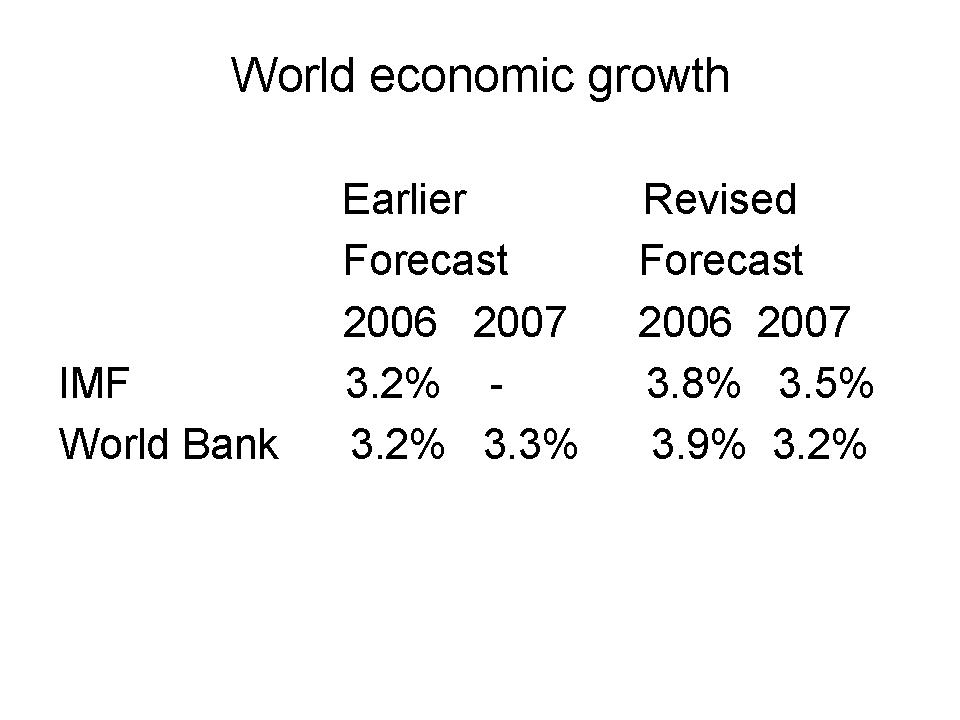
This has turned out to be a better year for the world economy than most people had expected. Both the IMF and the World Bank have revised upwards their projections for 2006. (See table alongside- the IMF forecasts from World Economic Outlook, September 2005 and September 2006; the World Bank forecasts are from Global Economic Prospects 2006 and 2007.). In 2007, both see a deceleration in growth with the IMF projecting a smaller deceleration than the World Bank. Note that the projected growth rates are still above the trend rate of 3% seen in the period 1980-2000.

So, the Cassandras have been proved wrong. They were telling us that the world economy would be on the skids for a number of reasons:

* Oil prices would go cross $100
* America's current account imbalances would unwind in ways that would derail the world economy
* America's housing sector would see a huge bust

So, what happened? Well, American current account imbalances remain. The housing sector has seen a slowdown but not a crash. But the biggest surprise has been oil prices. Oil prices were ruling above $75 in August. They have gone below $60. This is a level that the world economy can shrug off.

The decline in oil prices has meant that inflationary tendencies have been curbed everywhere and interest rate increases in the industrial world, including the US, have not seemed inevitable. In the US, the gradual slowing down of the economy- the much awaited 'soft landing'- has also meant that the US Fed has not been under pressure to raise interest rates.

I believe that one factor, more than anything else, has changed the global economic outlook dramatically: Israel's failed offensive on Lebanon in July.What's the connection?, you might wonder. It goes like this. America had planned an all-out assault on Iran, aimed at decimating Iran's nuclear facilities and defence infrastructure. But before this happened, the Iran-backed militia in Lebanon had to be neutralised. Otherwise, the Hezbollah would react to an American assault on Iran by launching long-distance missiles into the heart of Israel.

The Israelis got the opportunity they were looking for when the Hezbollah abducted two of their soldiers (although this was in retaliation for earlier Israeli abductions). They tried to pulverise the Hezbollah from the air. That didn't work. So they launched a ground offensive. To their chagrin, they ran, not into the sort of ragtag bunch of guerillas they had encountered in the West Bank and Gaza, but a force that was fully prepared for an invasion, well equipped and superbly trained. The offensive was called off.

This meant that war in the Gulf had been averted for the time being. The 'terror premium' built into oil prices vanished and oil prices started climbing down. That gave the world economy a huge boost. It follows that the key risk to the world economy in 2007 is America's policy towards Iran. The Bush-Blair duo faces a humiliating rout in Iraq and might want to salvage its legacy by announcing that Iran has ceased to be a nuclear threat to the world. If that happens, all bets on global economic growth continuing are off.

Barring a US-led war against Iran, the world economy should chug along and there is a good chance that growth will exceed the Fund-Bank forecasts in 2007.

Monday, December 18, 2006

Will the bull run continue?

The Sensex has recovered somewhat after the fall of nearly 7% last week. It has had a dream run since 1999 producing an annualised return of 23.7%. Will this continue? Many think it will. Swaminathan Aiyar, writing in the Times of India, argues that nominal GDP will grow at around 12.5%. Profits of the better companies will grow at at least 1.5 times nominal GDP. So the Sensex can be expected to grow at 18% in the next years and touch 30,000 whatever the intervening ups and downs.

Is this plausible? I see several problems in Aiyar's formulation. First, sales of top companies may grow faster than GDP but not necessarily profits.

Secondly, earnings growth in recent years are, to some extent, the result of savings in costs, including interest costs. These savings are not entirely sustainable. Besides, there will be earnings dilution arising from funds raised for capital expenditure.

Thirdly, in projecting a Sensex level of 30,000, Aiyar assumes that the current level is right. The P/E for the Sensex is around 24, way above its historical level.

In short, projecting an 18% annual rise in the Sensex from today's level appears unrealistic.

There is also the issue of what sort of returns we can expect from the equity market in the long run. The long-run premium in the US is 5.8%. For the world as a whole, it is 4.9% (based on an index of 16 developed country markets). That is the historical premium. An academic study (which I cite in my recent ET column) projects the future premium at 3%.

If we assume that returns in India over a long period of 20 years (the past seven years plus another 13 years)will approximate returns to a global index, we can most likely expect an annual return of 10% (assuming a 3% risk premium on a risk-free return of 7%). This return, according to the study I cite, has a probability of 50%

There is, of course, a chance that the coming decade will be a unique period of exceptionally high returns in the Indian market. But, going by a study on world-wide stock market returns, the probability that the annual return of 23.7% seen in the past seven years will be sustained is just 10%. There are no miracles in the stock market, you see.

I explore this theme in greater detail in my latest ET column.

Thursday, December 07, 2006

Reforms and growth

There is a fairy tale version of India's economic reforms that has seized the popular imagination. It goes like this. The Indian economy was comatose until 1991. Then, a brave band led by Narasimha Rao (or Manmohan Singh,if you like) strode in and waved a magic wand called 'reforms'. Private entrepreneurs then stepped in where the state had dominated the economy. ZOOM.... the Indian economy took off, never to look back again.

That, as I said, is the popular perception. The academic viewpoint tends to be rather different. It would highlight three key facts:

1. The 'structural break' in India's economic growth, occcured, not in 1991, but in 1980, a full decade before 'reforms' were said to be have been ushered in.

2. Growth accelerated from 6% to 8% in 2003-04 just when people had begun to give up on 'reforms' and were wringing their hands in despair over the opportunities being squandered by the Left-supported UPA government.

3. The state sector and public sector enterprises are very much part of the turnaround story.

Start with the first point. Enough studies have documented the acceleration in growth rate in the eighties to around 6% from the 'Hindu' rate of 3.5% in the preceding decades. In the nineties, the growth rate did not change significantly.

What caused the acceleration in the eighties? Well, there was a definite pro-business orientation and a loosening of controls in the eighties itself- so certain policy initiatives had occurred in the eighties itself, whether you want to call these 'reforms' or not.

What we saw in the nineties was a continuation and extension of policies that had already been initiated in the eighties. While the overall economic growth remained at around 6%, the driver of growth in the nineties was not industry, which had been the primary target of 'reforms', but the services sector. The services sector is much larger than IT- it comprises things such as real estate, finance, tourism, etc, areas that were largely untouched by the nineties' 'reforms'. This is one big puzzle that needs to be cracked by those who believe that it was the nineties' 'reforms' ushered in more rapid growth.

The next big puzzle for the 'reforms' brigade is the performance since 2003-04. The 'reforms' brigade argued that the momentum created by the first round of reforms had been spent and that growth could be accelerated or even sustained only if the 'second generation' reforms were pushed through- labour market reforms, cuts in subsidies, privatisation, downsizing of government, greater FDI, etc.

The UPA government showed itself averse to these. But the rebound in growth in 2003-04, just before the UPA government took over, has been sustained since. How come? The big difference certainly is the increase in savings rate of 5.5 percentage points from 23.5% to 29% of GDP. Of this, nearly 4 percentage points is accounted for by the turnaround in public savings. Increases in savings made higher investment possible and this has caused growth to accelerate. This bears out point (3) above, namely, that the state sector has contributed towards higher growth.

An important aspect of India's growth story is the performance of the IT sector. This contributed to the improvement in the balance of payments in the initial years after reforms. Nobody can deny that the state contributed in a big way to the IT story-through the huge investments in technical education and also through tax breaks.

I believe that lower interest rates are the key element in the India story. There has been a huge surge in foreign inflows- whether through remittances, FII or FDI- and this has caused interest rates to decline. Lower interest rates have caused public savings to rise, they have made exports more competitive and they have fuelled a huge increase in consumption as the demand for retail credit exploded. The surge in foreign inflows, in turn, reflects growing overseas (including NRI) confidence in the Indian economy, confidence created by two decades of sustained growth, not just growth in the nineties.

Taken together, points (1) to (3) make it clear that the Indian growth story is not just about private entrepreneurship having come of age. The story is rather more complex than that and it embraces the state sector as well. So, it is simplistic to suggest that we can now get to 10% simply by rolling back the state even further.

Read my ET column on this subject.

Sunday, December 03, 2006

Microfinance - a trifle hyped up?

The award of the Nobel peace prize for this year to Grameen Bank founder Mohammed Younus has evoked a barrage of peans in praise of microfinance. Here at last, it seems, there is a trusty cure for poverty. Don't give the poor handouts or jobs, let them help themselves by gaining access to credit. Give the poor a loan and you have the makings of an entrepreneur.

I have been rather sceptical of the claims made on behalf of microfinance and found my scepticism reinforced by a recent exchange between two redoubtable economist-bloggers, Richard Posner and Gary Becker, the latter a Nobel laureate himself.

Posner notes that microfinance fills a gap left unfilled by commercial banks who may be averse to taking the risks involved or may be constrained by interest rates they can charge. Microfinance takes over from informal loans made by relatives and clan members. It thus marks a transition from an economy based on trust to one to a normal commercial society.

Having placed microfinance in a conceptual framework, Posner goes to underline its shortcomings:


As a substitute for trust, microfinance has obvious drawbacks. Extremely high interest rates, though justified not only by the risk of default(and the opportunity cost of money, that is, the riskless interest rate) but also by the very high transaction costs of a tiny loan (since those costs are largely fixed,
rather than varying with the size of the loan), burdens the borrower with very heavy fixed costs, since he must repay the loan regardless of the success of his enterprise.....Borrowing at astronomical interest rates seems an unlikely formula for commercial success--and the more unlikely the poorer the borrower......

The evidence for the efficacy of microfinance in stimulating production and alleviating poverty is so far anecdotal rather than systematic. The idea of borrowing one's way out of poverty is passing strange. And I am unaware of any historical examples of nations that climbed out of poverty on the backs of small entrepreneurs financed by credit. Also, recall that Grameen Bank has lent almost $6 billion to some 6 million persons. This implies an average loan of almost $1,000, which in a country like Bangladesh is not chicken feed and makes one wonder how much of the Grameen Bank's loan portfolio is actually microfinance.....

I suggest, albeit tentatively, that there may be a good less to microfinance than its boosters claim.


In his response, Becker says that he does not believe that micro-finance loans are at market rates, that, is they price risk correctly. There is an element of subsidy in microfinance.It is the subsidy element in microfinance that explains why commercial banks have not ventured into micro-loans.

The Grameen Bank and other groups active in making micro loans have had some financing from NGO's that do not seek to make commercial returns on their spending. So my belief is that despite the seemingly "high" interest rates on these loans, they have earned returns, adjusted for servicing, risk, and other costs, that are below market interest rates in their respective countries

On the positive side, Becker notes that a big chunk of microfinance goes to women. To the extent that this enhances empowerment of women, it is welcome. So microfinance should be seen as a more effective way for private groups to make gifts to women that the customary handouts.

Microfinance will begin to make a big impact only when it becomes viable as a for-profit operation. That alone will make it a sustainable business model. It remains to be seen whether this challenge is addressed.

In India, microfinance is still very small in size with an estimated Rs 40 bn of total loans and mostly concentrated in four states in the south. The big impact on poverty will still come through job creation and through financial deepening, that is, commercial banks enlarging their reach and covering the under-served segments of society.

The danger with all the hype about microfinance is that it becomes an excuse for government and bankers to not do their bit- hey, we have microfinance, so why should the government or commercial banks bother about poverty alleviation?

Friday, December 01, 2006

Much ado about outward FDI

The Tata group's bid for Corus hangs in the balance. When Corus management indicated its acceptance of the Tata offer, the response in India was euphoric. Corporate India, the pundits said, had come of age. Indian companies would now sally forth and conquer. We should soon expect outward FDI to exceed inward FDI.

Calm down, folks. Yes, there will be overseas acquisitions, more so as the rupee appreciates. But not many companies are in a position to bring off deals of this size- they do not have the financial muscle or the stature to put together deals of this order. Others, such as software companies, have chosen to go in for small acquisitions ($50 million or so) because their problem is managing high rates of organic growth.

Not just software companies but those in pharmaceuticals, automotives and bio-tech find they are able to compete in the international marketplace from out of India. Knowing the hassles that go with large acquisitions- the majority of cross-border acquisitions fail to enhance shareholder value- they will play it safe and make relatively small acquisitions.

As for the impact of balance of payments, we need to factor in the following:

i. The bigger deals will be funded overseas, so will not entirely involve outward FDI.

ii. Most acquisitions, as stated above, will be small.

iii. Inward FDI is today very low in relation to the potential of the Indian economy and is bound to rise sharply.

For these reasons, net FDI (inward minus outward) will remain positive.

Read my ET column on the subject.