After some humming and hawing, the finance ministry has sanctioned performance bonuses for public sector bank chairmen-and-managing directors and executive directors. Chairmen will get bonuses of Rs 0.6, 0.7 and 0.8 mn depending on whether they meet 60-80%, 81-99% and 100% of targets. For executive directors, the bonuses will be Rs0.4, 0.55 and 0.65 million against meeting targets.
I think that the scheme is a bad idea. I oppose it on conceptual grounds, on grounds of implementation and on the ground that selectivity in giving rewards is not in an organisation's interest.
The conceptual grounds: Banks are highly leveraged institutions. We know from finance theory that the existence of debt creates extra incentives for taking risk on the part of management. That's because if a risky bet fails, it's debt-holders who will mostly be left holding the can. It does not make sense to create further incentives for risk-taking through performance-linked bonuses.
Yes, you can create additional incentives for risk-taking provided you are in a position to track the extra risk taken and ensure that capital is provided against risk- as is intended in Basel II. Then, you measure returns on risk-adjusted capital (RORAC). Indian banks are far from that stage. I say: if you can't track the risk that management is taking, don't create rewards for risk-taking.
The implementation grounds: Measuring performance at the best of times is a difficult proposition. The finance ministry proposes a slew of quantitiative parameters (weight of 85%) and qualitative parameters (15%). The quantitative parameters relate to meeting targets. This can easily lead to "gaming" of targets- bank chiefs can set targets that are easily attained. Measuring qualitative parameters such as leadership or customer satisfaction bristles with problems.
It would be much better to measure relative stock performance (relative to the Banking index as well as the market index). It would also be useful to measure improvements in the price-earnings multiple of public sector banks, given that these banks enjoy very low multiples at the moment. The measures proposed by the ministry are unsatisfactory.
Selectivity: I don't know how many public sector banks have performance-based incentives at all levels. Giving performance-based rewards only to people at the top is not the best way to motivate those lower down.
I understand where the ministry and the banks are coming from. Top management compensation in public sector banks is hopelessly out of sync with market realities. But so is compensation at senior management levels. The answer is to revise the compensation structure in banks.
But this means three things. One, public sector banks cannot have a common compensation structure: pay must be related to capacity to pay. Bank unions must accept this and abandon their insistence on banking sector-wide compensation settlements. Two, increases will be related to market compensation for a given position. This means, higher increases in some cases and lower increases in others. Unions must accept this well.
Third- and by no means the least important- the bureaucracy must accept that public sector pay cannot use bureaucrats' pay as the starting point. Bank chairmen may get more than secretaries at the centre.
I hope the Sixth Pay Commission brings some fresh thinking to bear on the subject of pay at public sector enterprises. Otherwise, HRD is going to be a serious problems for PSEs in the years ahead. Maybe that's what some people want? Then, they have a ready excuse for pushing ahead with privatisation, no?
Wednesday, March 21, 2007

Tuesday, March 20, 2007
Slavery
Britain marks the 200th anniversary of the abolition of slavery. With its penchant for doing offbeat items every now and then, the Economist (February 24) carries a detailed report on the slave trade.
The sheer scale of the slave trade is mind-boggling: some 20 million Africans were shipped across the Atlantic between the 15th and 19th centuries. The question for researchers is similar to the one that those investigating the holocaust the Nazis perpetrated on the Jews asked themselves: how could decent people accept that sort of thing?
One answer, as in the case of the Nazis, is clever concealment. There was no slavery in England itself; it all happened in distant plantations. Those who campaigned against slavery later had to fight hard to produce evidence to convince the public. But that was not all. Another was the use of euphemisms to aid denial.
All the leading nations of the time were involved- Britain, America, France, Denmark, Portugal. For the Africans, some of whom are demanding compensation of one sort or another, the painful part of the story is the role played by their compatriots. The slave trade could not have happened without the active participation of African tribes. Most of the slaves sold were men and women captured in battles between tribes. One of the most notorious slave emporiums, Cape Coast Castle in today's Ghana, stood on land rented to the British by a local chief.
The Economist piece leaves you numb with horror. But, hang on, slavery did not quite end in the nineteenth century. A report in the Financial Times(March 17) tells us that slavery is still alive and kicking. Only, it goes by a more modern name, "human trafficking".
The silver lining, as the report points out, is that slavery is illegal in almost every country and hence can be ended. The only requirement is that the public and governments make ending slavery a priority.
The sheer scale of the slave trade is mind-boggling: some 20 million Africans were shipped across the Atlantic between the 15th and 19th centuries. The question for researchers is similar to the one that those investigating the holocaust the Nazis perpetrated on the Jews asked themselves: how could decent people accept that sort of thing?
One answer, as in the case of the Nazis, is clever concealment. There was no slavery in England itself; it all happened in distant plantations. Those who campaigned against slavery later had to fight hard to produce evidence to convince the public. But that was not all. Another was the use of euphemisms to aid denial.
The means by which sugar lumps arrived on tables in polite society were carefully hidden. The young officers of the African Service who volunteered to man the slave forts and oversee the dungeons were children of the age of enlightenment. They saw themselves as well-endowed with all the refined feelings and sensibilities that could be expected of a gentleman.
Those fine feelings were spared from reality by careful euphemisms. There were no slave-traders; only “adventurers” in the “Africa” or “Guinea” trade. Prints of the gleaming white Cape Coast Castle made it look like a European palace; there was no hint at its real role. Shackles used to string captives together were just “collars”. The “Company of Merchants”, which ran Britain's slave trade, had on its logo an elephant and a beehive—denoting Africa and America—but nothing about slaves.
Of an evening, officers of the African Service might peruse a new work of history or philosophy: an eerie precursor of the Nazi officers who relaxed to the sound of Beethoven after a day in the gas chambers.
But there was still a pervasive feeling that, despite all the evasions, those involved in the trade were doing something deeply wrong. In the courtyard of Cape Coast Castle lies the tomb of Philip Quaque, the chaplain to the officers and men of the castle for 42 years in the second half of the 18th century. During all that time he failed to bring a single officer to the Christian rite of Holy Communion. In a letter he reflected that this had nothing to do with his (black) skin-colour, and more to do with a mood of shame: “The only plea they offer is that while they are here acting against Light and Conscience they dare not come to that holy Table.”
All the leading nations of the time were involved- Britain, America, France, Denmark, Portugal. For the Africans, some of whom are demanding compensation of one sort or another, the painful part of the story is the role played by their compatriots. The slave trade could not have happened without the active participation of African tribes. Most of the slaves sold were men and women captured in battles between tribes. One of the most notorious slave emporiums, Cape Coast Castle in today's Ghana, stood on land rented to the British by a local chief.
The Economist piece leaves you numb with horror. But, hang on, slavery did not quite end in the nineteenth century. A report in the Financial Times(March 17) tells us that slavery is still alive and kicking. Only, it goes by a more modern name, "human trafficking".
In this 200th anniversary year of the abolition of the slave trade in the British empire, slavery is turning up in surprising places. The trade may have been outlawed, but the practice still reaches into our homes and businesses, perhaps more than we realise. Most of us learn about modern slavery from the bottom up, in the heart- wrenching stories of individuals enslaved in the developing world or trafficked into forced labour in the west. But there is a larger, historic, top-down account that is only now becoming clear as activists and scholars explore the role of slavery in the global economy. With the end of the cold war, human trafficking and slavery have bounced back as businesses.
The United Nations reports that human trafficking is now the third largest moneymaker for criminals, after drugs and weapons. No one is sure how many people were enslaved 50 years ago, but the number is thought to have grown rapidly with the population explosion to an estimated 27 million today. The increase in slavery is also linked to globalisation. But this is not about sweatshop workers existing on miserly wages. Slaves are under the complete, violent control of another person; they are economically exploited, and get only enough food and shelter to keep them alive. For millions of victims, their experience differs little in hardship from that of slaves hundreds of years ago....
With the growth of global markets, some of these slaves are used to produce many of our basic commodities. In Brazil, for example, slaves cut down forests and burn the wood into charcoal to be used to make steel. The European Union imports nearly a million tonnes of Brazilian steel each year to produce everything from cars to buildings to toys. Slavery is in fruit bowls and fridges too. There are documented cases of slaves being used to harvest or produce coffee, sugar, beef, tomatoes, lettuce, apples and other fruit. The list goes on: shrimp and other fish products are suspect, as are cocoa, steel, gold, tin, diamonds, jewellery and bangles, tantalum (used in mobile phones and laptops), shoes, sporting goods, clothing, fireworks, rice, bricks....
In south Asia, hereditary "debt bondage slavery" is common. Loans are made to families in a financial crisis - for example, crop failure - and since they have no assets, all the work they do must serve as collateral until the loan is repaid. The debt is passed from one generation to the next; up to 10 million people are thought to be held in hereditary debt bondage slavery in India, Pakistan and Nepal.
The silver lining, as the report points out, is that slavery is illegal in almost every country and hence can be ended. The only requirement is that the public and governments make ending slavery a priority.
Whatever goes up.......
The Indian stock market, along with the other BRIC economies (Brazil, Russia and China), has hogged the lion's share of portfolio flows into emerging markets in recent years. That has sent the markets rocketing up. The downturn, when investors get jittery and pull out, can be as severe as the upswing. ET (March 20) reports:
Is this kind of volatility bad? Well, ups and downs in the stock market do not by themselves pose any systemic risk in well regulated financial markets, such as India. The wealth effect of stock prices also tends to be small. But volatility in portfolio inflows causes volatility in exchange rates. This can be unsettling for firms.
In India, the RBI has had to intervene to limit rupee appreciation caused by inflows because it is not sure whether the inflows will continue. Whenever foreign portfolio capital exits, it causes rupee depreciation. RBI intervention increases money supply. This has to be neutralised by open market operations which causes interest rates to rise. Managing money supply and interest rates in the face of large and uncertain capital flows is a big problem for emerging market regulatory authorities.
China, India and Russia are losing their allure for stock investors because corporate profits are showing signs of flagging, even as their economies grow at some of the fastest rates in the world.
Stock markets in the three countries are among the 10 worst performers this year. Together with Brazil, they’ve fallen twice as much as developing nations as a whole. In the past five years, each market has at least tripled, helped by an economic boom that exceeds 10% a year in China. Now, growth is stoking inflation and straining production. .....
Russia’s ruble-denominated Micex Index has surged at an average annual rate of 48% for the past five years, the best performance of the four. The Hang Seng China Enterprises Index, tracking shares of mainland companies that international investors can buy and sell freely in Hong Kong, posted average gains of 37%, and India’s Sensitive Index added an average 34%. Brazil’s Bovespa index had an annualised advance of 27% during the same period....
By comparison, the MSCI emerging-markets index rose 26% each year on average, while the Standard & Poor’s 500 Index in the US climbed at a 3.8% rate. Last year, BRIC-related stock funds garnered a net $18.7 billion. The net inflows equaled 83% of the record $22.4 billion for all emerging markets and the most since Emerging Portfolio Fund Research started compiling figures in 1995.
BRIC markets were the hardest hit during a global sell-off, sparked by a plunge in China’s mainland markets on February 27, which wiped away $3.3 trillion in value worldwide in a week. “In the short term, what people want to do is to reduce risk, and these markets are definitely going to be punished,” said Rudolph-Riad Younes, who helps oversee $58 billion as head of international equities at Julius Baer Investment Management in New York.
Is this kind of volatility bad? Well, ups and downs in the stock market do not by themselves pose any systemic risk in well regulated financial markets, such as India. The wealth effect of stock prices also tends to be small. But volatility in portfolio inflows causes volatility in exchange rates. This can be unsettling for firms.
In India, the RBI has had to intervene to limit rupee appreciation caused by inflows because it is not sure whether the inflows will continue. Whenever foreign portfolio capital exits, it causes rupee depreciation. RBI intervention increases money supply. This has to be neutralised by open market operations which causes interest rates to rise. Managing money supply and interest rates in the face of large and uncertain capital flows is a big problem for emerging market regulatory authorities.
Greenspan the bear
As Chairman of the Fed for 18 years, Greenspan was said to be responsible for creating for more than one asset bubble. He was bullish about on many subjects: a breakthrough in productivity in the US, sustained high growth rates of the US economy, soaring property and stock prices, the health of the financial sector. The Economist magazine held him squarely responsible for too much money sloshing around the markets when he quit.
Now, he seems to have turned bear He thinks the sub-prime market problem in the US will worsen and he also sees a recession setting in by the end of the year. That is making a whole lot of people livid, including people who went along with his bullish views. His detractors say that the markets are not taking him seriously- the same markets that hung on to his words when he was Fed Chief. A Bloomberg story in ET (March 19) has the following quote:
Now, he seems to have turned bear He thinks the sub-prime market problem in the US will worsen and he also sees a recession setting in by the end of the year. That is making a whole lot of people livid, including people who went along with his bullish views. His detractors say that the markets are not taking him seriously- the same markets that hung on to his words when he was Fed Chief. A Bloomberg story in ET (March 19) has the following quote:
"Its definitely true that his influence is waning," said Hayes Miller, who helps oversee $38 billion at Baring Asset Management in Boston. "He may be over-playing his position in the world, even as an ex- Fed chief."
Friday, March 16, 2007
Three big banks run into rough weather
Interesting. Three of the world's top banks have run into rough weather. HSBC is having to cope with the problems created by its acquisition of a mortgage finance company in the US (See my post, Shocker from HSBC, March 8). Rising defaults in the US sub-prime market have caused HSBC to issue its first profit warning in decades.
HSBC is in good company. Citigroup's CEO, Chuck Prince,has been facing flak for sometime thanks to the stock's underperformance for the past five years. Citigroup, the world's biggest bank, has faced regulatory problems in different parts of the world and tightening compliance has been one of the priorities for its CEO. Most recently, it has faced a probe by the SEC regarding tax matters related to one of its acquisitions.
Under Prince's charismatic predecessor, Sandy Weill, Citigroup powered ahead through a series of acquisitions.Digesting those acquisitions has proved a problem for Prince. So, he has focused on growing the bank organically. For a bank of Citigroup's size, this is not easy. Citigroup's growth must come from its international operations- Prince wants to raise the share of international revenues from 45% to 60%. But this must be done without inviting fresh regulatory problems.
Citigroup's latest gamble is the planned acquisition of Japanese broker, Nikko Cordial, a firm that is caught in an accounting scandal. At twice the book value, Citigroup will pay through its nose. Besides, Citigroup and other foreign banks have had regulatory problems in Japan. Citigroup's readiness to plough ahead is a measure of its desperation to produce results.
Elsewhere, Dutch bank ABN Amro is facing demands from a leading hedge fund investor to get its act together. ABN Amro again has to sought to grow through acquisition in Europe but it is having problems with its purchase of an Italian bank. That acquisition is in line with ABN's strategy of being a strong regional player rather than a global player. But, like Citigroup, it is finding that making acquisitions work is not easy. There are already rumours of ABN Amro becoming a takeover target itself- with Citigroup as a possible contender.
You can see what is common to the three banks: they judged that they could not grow fast enough organically and tried to grow through acquisition. But such growth is not delivering shareholder value. There is one place where growth through acquisitions may make sense for banks such as HSBC and Citigroup: emerging markets. Trouble is, the two biggest markets, India and China, are not open to such possibilities.
The lesson? Beware of the lure of growth through acquisition unless there are huge gains that are easily had. It also follows that when organic growth is possible, there is nothing like it. That's why I've been wary of the clamour for consolidation among the larger public sector banks. In the last few years, these banks have seen very good growth. If such possibilities begin to shrink, then- and only then- should they think of consolidation.
HSBC is in good company. Citigroup's CEO, Chuck Prince,has been facing flak for sometime thanks to the stock's underperformance for the past five years. Citigroup, the world's biggest bank, has faced regulatory problems in different parts of the world and tightening compliance has been one of the priorities for its CEO. Most recently, it has faced a probe by the SEC regarding tax matters related to one of its acquisitions.
Under Prince's charismatic predecessor, Sandy Weill, Citigroup powered ahead through a series of acquisitions.Digesting those acquisitions has proved a problem for Prince. So, he has focused on growing the bank organically. For a bank of Citigroup's size, this is not easy. Citigroup's growth must come from its international operations- Prince wants to raise the share of international revenues from 45% to 60%. But this must be done without inviting fresh regulatory problems.
Citigroup's latest gamble is the planned acquisition of Japanese broker, Nikko Cordial, a firm that is caught in an accounting scandal. At twice the book value, Citigroup will pay through its nose. Besides, Citigroup and other foreign banks have had regulatory problems in Japan. Citigroup's readiness to plough ahead is a measure of its desperation to produce results.
Elsewhere, Dutch bank ABN Amro is facing demands from a leading hedge fund investor to get its act together. ABN Amro again has to sought to grow through acquisition in Europe but it is having problems with its purchase of an Italian bank. That acquisition is in line with ABN's strategy of being a strong regional player rather than a global player. But, like Citigroup, it is finding that making acquisitions work is not easy. There are already rumours of ABN Amro becoming a takeover target itself- with Citigroup as a possible contender.
You can see what is common to the three banks: they judged that they could not grow fast enough organically and tried to grow through acquisition. But such growth is not delivering shareholder value. There is one place where growth through acquisitions may make sense for banks such as HSBC and Citigroup: emerging markets. Trouble is, the two biggest markets, India and China, are not open to such possibilities.
The lesson? Beware of the lure of growth through acquisition unless there are huge gains that are easily had. It also follows that when organic growth is possible, there is nothing like it. That's why I've been wary of the clamour for consolidation among the larger public sector banks. In the last few years, these banks have seen very good growth. If such possibilities begin to shrink, then- and only then- should they think of consolidation.
Thursday, March 15, 2007
Where's the Sensex headed?
Citigroup unveils its forecast (ET, March 15):
Err.... could we have Citigroup's forecasts for the past three years?
Announcing their target values, Citigroup’s regional equity strategist, Markus Rosgen, has set a target of 14700 to 16000 for the Sensex as of December 2007..
This is based on a fair value of 13300 for Sensex and 10-20% premium on account of higher ROE’s(return on equity) and expected upgrade momentum for earnings estimates.
......Citigroup expects earnings growth of its Indian universe at around 15-20% and expects growth rates to trend downwards from current cyclical peak of around 25%
Err.... could we have Citigroup's forecasts for the past three years?
What's wrong with SEZs?
Nandigram in West Bengal is boiling. At least 11 protesters were killed in police firing yesterday. Nandigram, where the state government plans to acquire 10,000 acres of land for Indonesia's Salim group, has been out of bounds for the police for the past few weeks and yesterday's violence erupted when police attempted to enter the area.
Nandigram is grabbing headlines. Another project that has not been in the news but is also facing trouble is Reliance's proposed SEZ in Jhajjar district in Haryana. In the past week, locals have held demonstrations to protest planned land acquisition in the area.
Land acquisition is the most controversial part of SEZs and I have touched upon this in earlier posts. But from an economist's standpiont too, SEZs pose problems, as Nitin Desai points out in a well-argued article in today's Business Standard.
The primary problem is not just the tax concessions extended to SEZs and potential loss of revenue to the government. As the Commerce ministry has pointed out, this loss is temporary and can be more than made up over time once the tax-free period ends. The problem, as Desai points out, is that SEZs take us back to the era of discretionary government powers and lobbying by industrial houses.
SEZs, Desai says, are "business-friendly" but they are not "market-friendly". In a market-friendly policy regime, any businessman would be able to avail of the facilities and regulations that apply to SEZs- infrastructure, low tariffs, relaxed environmental and labour regulations, etc. Government is not able to make these generally available. So, it makes these available at select places- and to select businessmen.
But doesn't China have SEZs? Desai addresses this favourite argument of those who want to push through their schemes. China has six large SEZs- Shenzen is 50,000 hectares in size. We plan to have SEZs in hundreds, many of them quite small, some only 40 hectares in size.
Secondly, China's SEZs were meant to confine economic liberalisation to a few pockets; for the most part, the public-sector dominated economy was to be protected. That is not our idea of liberalisation. Our objective is to liberalise across the board but gradually. The two approaches are not comparable.
Nandigram is grabbing headlines. Another project that has not been in the news but is also facing trouble is Reliance's proposed SEZ in Jhajjar district in Haryana. In the past week, locals have held demonstrations to protest planned land acquisition in the area.
Land acquisition is the most controversial part of SEZs and I have touched upon this in earlier posts. But from an economist's standpiont too, SEZs pose problems, as Nitin Desai points out in a well-argued article in today's Business Standard.
The primary problem is not just the tax concessions extended to SEZs and potential loss of revenue to the government. As the Commerce ministry has pointed out, this loss is temporary and can be more than made up over time once the tax-free period ends. The problem, as Desai points out, is that SEZs take us back to the era of discretionary government powers and lobbying by industrial houses.
The SEZs involve discrimination and discretion. The discrimination is between the policy regimes that apply to producing units within the domestic tariff area and those within the SEZs. The discretion lies in the case-by-case approval of proposals to set up these SEZs. Both of these involve a significant departure from a market-friendly system. Sooner or later they degenerate into what we politely call rent-seeking by politicians, bureaucrats and their business cronies. In some ways the SEZ policy marks a reversal of a trend towards non-discriminatory and non-discretionary regulatory regimes that started in 1991.
The SEZs are meant to drive rapid export expansion. But export production and production for the domestic market should not be separated in a sensibly-run economy. In an open trade regime with low tariffs there is no essential distinction between the two.
SEZs, Desai says, are "business-friendly" but they are not "market-friendly". In a market-friendly policy regime, any businessman would be able to avail of the facilities and regulations that apply to SEZs- infrastructure, low tariffs, relaxed environmental and labour regulations, etc. Government is not able to make these generally available. So, it makes these available at select places- and to select businessmen.
But doesn't China have SEZs? Desai addresses this favourite argument of those who want to push through their schemes. China has six large SEZs- Shenzen is 50,000 hectares in size. We plan to have SEZs in hundreds, many of them quite small, some only 40 hectares in size.
Secondly, China's SEZs were meant to confine economic liberalisation to a few pockets; for the most part, the public-sector dominated economy was to be protected. That is not our idea of liberalisation. Our objective is to liberalise across the board but gradually. The two approaches are not comparable.
The bottom line is that the SEZs do not address and in fact work against what is really needed—an economic policy that promotes competition, innovation and growth throughout the economy, an urban policy that focuses on affordable housing and services for all, a social policy that actively expands opportunities for all regions and classes and a political policy that bridges the divide between those who support continuing reform in the role of government and those who fear the rigours of liberal capitalism.
Wednesday, March 14, 2007
Winds of change at Harvard
Harvard university is revisiting its undergrad curriculum. This is happening after three decades! Shows just how slow the best of universities can be in ushering in change.
FT reports (March 14):
The new curriculum design would be any educator's dream:
You can see the committee's thinking. Identify the skills needed. Then, identify the courses that would provide the skills.
Biology and physics/chemistry would be part of any existing curriculum. Ethics and philosophy would not be uncommon, as also literature, art and music and data evaluation.
What is new, as I see it, are the elements that help the young student relate to the world at large and understand the sources of conflict in the modern world: ethinic identity and statehood; culture and belief; and the US and the world, especially important because Americans are amongst the most insular people in the world today.
In a word, the revamped curriculum is all about helping students relate to globalisation. That is as it should be. "Internationalisation" of programmes is something of a buzzword today but, like many buzzords, it is in danger of being trivialised.
Too many institutions, especially business schools, think "internationalisation" has to do with students visiting foreign lands or having foreign students come over- "exchange programmes" are the flavour of the day. There is, of course, a place for travel but there is more to "internationalisation" of programmes than globe-trotting. After all, tour operators can do a decent job of travel, we don't need universities to do that.
No, "internationalisation" must be primarily about changing the curriculum to reflect changes in the world at large, it must be about bringing in the international dimension to learning.We need to develop citizens who have basic skills and knowledge and who can also intelligently relate to what is going on in the world. That is what Harvard is attempting with its new curriculum.
There's just a little footnote I would like to add. Larry Summers, the distinguished economist and former US treasury secretary who was President of Harvard, tried his damndest to ring in changes at Harvard. One of his main concerns was the undergrad curriculum. He was defeated by a faculty body that was resistant to change and that was also resistant to anybody telling them they needed to improve. It must be gratifying for Summers to see that faculty have had to respond, after all, to the clamour for change, even if somewhat belatedly.
FT reports (March 14):
Harvard, the richest, oldest, and arguably most influential university in America, is on the verge of overhauling its curriculum for the first time in three decades – and in doing so, helping redefine what it means to be an educated person in the 21st century.
A recent report by a panel of professors tasked with revamping the school’s general education programme calls for courses designed to help prepare students to contribute to civic life, respond to change in society, and grasp the ethical implications of their actions. Because everything that happens at Harvard sends ripples throughout the academic world, university officials throughout the US are watching the report closely. “Our aim was to help students try to draw connections between what they are learning in the classroom and their 21st-century lives,” said Alison Simmons, co-chair of the task force and a professor of philosophy.
“We’re not trying to say that an educated man or woman needs to know this, that and the other.
“What we’re saying is that an educated person should have a certain set of capacities: interpretive capacities, problem-solving capacities, reflective capacities and critical capacities to help them through the world,” she said. Harvard’s current core curriculum, which was designed in the 1970s, has been faulted for allowing professors to teach whatever narrow and obscure subjects interest them and for placing too little emphasis on the quality of undergraduates’ academic experience.
The new curriculum design would be any educator's dream:
Under the new curriculum, each student would be required to take one course in each of eight categories. These include: science of living systems; science of the physical universe; societies of the world, which will cover ethnic identity, statehood and government; empirical reasoning, which will include courses on evaluating data; and ethical reasoning, which will cover philosophy, political theory and religion.
The three other areas are: aesthetic and interpretive understanding, which focuses on cultural expression, such as literature, art and music; culture and belief, which would place those works in context; and the US in the world, which is meant to give students a “nuanced understanding of American society”.
The report also promotes an initiative in “activity-based learning” that would link academic work with students’ Harvard-sponsored extra-curricular activities, such as writing for the student newspaper or performing in a dance troupe, as well as pursuits outside the university, such as volunteering for a political campaign or taking a placement as an intern at a company
You can see the committee's thinking. Identify the skills needed. Then, identify the courses that would provide the skills.
Biology and physics/chemistry would be part of any existing curriculum. Ethics and philosophy would not be uncommon, as also literature, art and music and data evaluation.
What is new, as I see it, are the elements that help the young student relate to the world at large and understand the sources of conflict in the modern world: ethinic identity and statehood; culture and belief; and the US and the world, especially important because Americans are amongst the most insular people in the world today.
In a word, the revamped curriculum is all about helping students relate to globalisation. That is as it should be. "Internationalisation" of programmes is something of a buzzword today but, like many buzzords, it is in danger of being trivialised.
Too many institutions, especially business schools, think "internationalisation" has to do with students visiting foreign lands or having foreign students come over- "exchange programmes" are the flavour of the day. There is, of course, a place for travel but there is more to "internationalisation" of programmes than globe-trotting. After all, tour operators can do a decent job of travel, we don't need universities to do that.
No, "internationalisation" must be primarily about changing the curriculum to reflect changes in the world at large, it must be about bringing in the international dimension to learning.We need to develop citizens who have basic skills and knowledge and who can also intelligently relate to what is going on in the world. That is what Harvard is attempting with its new curriculum.
There's just a little footnote I would like to add. Larry Summers, the distinguished economist and former US treasury secretary who was President of Harvard, tried his damndest to ring in changes at Harvard. One of his main concerns was the undergrad curriculum. He was defeated by a faculty body that was resistant to change and that was also resistant to anybody telling them they needed to improve. It must be gratifying for Summers to see that faculty have had to respond, after all, to the clamour for change, even if somewhat belatedly.
Tuesday, March 13, 2007
Sub-prime market woes deepen
Will the sub-prime mortage market in the US prove the trigger for the correction in financial markets that many analysts have long been predicting? I flagged this issue in an earlier post (Shocker from HSBC). At the time, it seemed the problem might just be manageable. But with each passing day, doubts grow. The Financial Times (March 13) reports on the latest collapse in this market:
The problem is two fold. One, as the sub-prime lenders go under, they drag down banks who have lent to them and those in the derivatives market who have positions on sub-prime loans. Two, as sub-prime loans dry up, property prices tumble, dragging down more players and creating further problems for those exposed to sub-prime lenders. A further decline in housing prices will mean further decleration in the US economy and an increase in non-performing assets in other sectors as well. So, the billion dollar question remains: can the problems in the sub-prime market be contained?
Trading was halted in New Century Financial on Monday with the second-largest US subprime lender teetering on the edge of bankruptcy, sparking fresh fears about whether turmoil in the sector could spread and damp US economic growth.....
The rapid decline of New Century, the latest problem at US subprime lenders, raised concerns that problems could spread in the $8,000bn mortgage industry and to other parts of the capital markets.
The problem is two fold. One, as the sub-prime lenders go under, they drag down banks who have lent to them and those in the derivatives market who have positions on sub-prime loans. Two, as sub-prime loans dry up, property prices tumble, dragging down more players and creating further problems for those exposed to sub-prime lenders. A further decline in housing prices will mean further decleration in the US economy and an increase in non-performing assets in other sectors as well. So, the billion dollar question remains: can the problems in the sub-prime market be contained?
Lalu Yadav is going places.......
The re-branding of Railway Minister Lalu Yadav is gathering steam.
Today's Ahmedabad Times reports that in April, Lalu has speaking engagements in three top business schools in the US: Harvard, Stanford and Chicago. Students from Harvard and Wharton have already met him while on a tour of India. More b-school students are scheduled to do so. I suppose IIM-A can take credit for having started it all by inviting Lalu over.
The turnaround of the Indian Railways (IR) is a big story because many rail systems in the world are in trouble. As I wrote in an earlier post (Lalu Yadav is no liberaliser), Lalu has succeeded by eschewing the coventional reformist route. Today, in TOI, Lalu makes the point that he has made IR commercially successful without privatising or downsizing. Very true. But, I repeat, one must not get carried away and ascribe the turnaround to one man. It is IR's formidable technocratic strengths that have created the turnaround.
Today's Ahmedabad Times reports that in April, Lalu has speaking engagements in three top business schools in the US: Harvard, Stanford and Chicago. Students from Harvard and Wharton have already met him while on a tour of India. More b-school students are scheduled to do so. I suppose IIM-A can take credit for having started it all by inviting Lalu over.
The turnaround of the Indian Railways (IR) is a big story because many rail systems in the world are in trouble. As I wrote in an earlier post (Lalu Yadav is no liberaliser), Lalu has succeeded by eschewing the coventional reformist route. Today, in TOI, Lalu makes the point that he has made IR commercially successful without privatising or downsizing. Very true. But, I repeat, one must not get carried away and ascribe the turnaround to one man. It is IR's formidable technocratic strengths that have created the turnaround.
Monday, March 12, 2007
This year's budget is about 2008-09, not 2007-08
Anyone commenting on the budget more than ten days after it has been presented risks being thought a bore. But I am going to be brave. I think there's a case for a relaxed view of the budget after the frenzied coverage on and around budget day.
The Union budget has become something of a spectator sport- like the World Cup one-dayers. There is a huge build-up of interest ahead of the event. You have saturation coverage in the visual and print media on the day of the budget and a couple of days thereafter. Then the budget vanishes from view.
Is this a problem? I think so because it's hard to get a handle on the budget without spending a little time on the budget papers. The sort of hurried analysis and comment we have now can be misleading- and, in fact, it gives finance ministers a chance to manipulate public opinion.
The budget analysis in some ways illustrates the classic problem of the information age: too much data and too little understanding. We were,perhaps, better off in the old days when there was no Internet and no business channels on TV and the budget papers were available as hard copy. The newspapers then dissected the budget over several days and it was possible to have an informed assessment. Now, we have instant judgements delivered on budget day- and zero analysis thereafter.
This is not going to go away. Finance minister P Chidambaram has been quoted as saying that the budget should be regarded as no more than a statement of government accounts. I doubt that the media is in a mood to listen and tone down its coverage. The budget is big bucks for the media, so they have an interest in perpetuating the hype.
I touch upon this problem in my latest ET column. This budget was supposed to be all about aam admi. The finance minister was supposed to have failed on reforms but succeeded in doing a lot for the social sectors. Look carefully at the budget numbers and you find very little to support this claim.
Read my full article in ET here.
But that begs the question. If the finance minister did not push reforms- especially in terms of reducing tax rates- and if he did not do much on the expenditure side either, what did he do at all in the budget? Not much, I am afraid. That may seem strange considering that the economy is booming and so are tax revenues. Surely, the FM could afford to cut tax rates or spend more?
The answer to the puzzle lies, I think, in the revenue projections for 2007-08. The FM shows tax revenues rising by just 17% in the coming year compared to 28% in 2006-07. That does seem too conservative. Assuming tax revenue growth just a little lower than in the current year- say, 25%- would have placed another Rs 28,000 crore the FM's disposal. He could then have allocated a great deal more for Plan capital expenditure, an item greatly neglected in budgets in recent years.
For those not familiar with the jargon, Plan capital expenditure is public investment of the sort that will have payoffs in future (as distinct from capital expenditure for maintenance purposes or in areas such as defence). How can you expect agriculture to do better if you don't invest in a big way in irrigation, dryland development, extension services, etc? You can't say you care for aam admi and then ignore public investment in agriculture.
So, if he has revenues at his disposal, why on earth did the FM not spend where required? Here's my explanation. I believe Mr Chidambaram is looking ahead to his next budget for 2008-09. The Sixth Pay Commission recommendations will be out in 2008. In his next budget, the FM will have to make a significant provision for higher salaries in government. Besides, elections will be round the corner and higher spending on various social heads will be required.
In other words, the FM will have step up expenditure significantly next time. While doing so, he has to meet the FRBM Act target of 3% for the fiscal deficit for 2008-09. For 2007-08, the deficit is projected at 3.3%. I suspect it will be lower- closer to 3%. But, to keep the fiscal deficit at 3% in the following year, he needs the cushion in revenues that he gets by not spending heavily this year. He keeps expenditure in check this year by simply under-estimating revenues.
For Mr Chidambaram, the FRBM targets are sacrosanct. He would like to go out next year in a blaze of glory as the FM who kept the nation's tryst with the FRBM target for 2008-09. That would explain the numbers we are seeing in the budget this time on the revenue as well as expenditure side.
The Union budget has become something of a spectator sport- like the World Cup one-dayers. There is a huge build-up of interest ahead of the event. You have saturation coverage in the visual and print media on the day of the budget and a couple of days thereafter. Then the budget vanishes from view.
Is this a problem? I think so because it's hard to get a handle on the budget without spending a little time on the budget papers. The sort of hurried analysis and comment we have now can be misleading- and, in fact, it gives finance ministers a chance to manipulate public opinion.
The budget analysis in some ways illustrates the classic problem of the information age: too much data and too little understanding. We were,perhaps, better off in the old days when there was no Internet and no business channels on TV and the budget papers were available as hard copy. The newspapers then dissected the budget over several days and it was possible to have an informed assessment. Now, we have instant judgements delivered on budget day- and zero analysis thereafter.
This is not going to go away. Finance minister P Chidambaram has been quoted as saying that the budget should be regarded as no more than a statement of government accounts. I doubt that the media is in a mood to listen and tone down its coverage. The budget is big bucks for the media, so they have an interest in perpetuating the hype.
I touch upon this problem in my latest ET column. This budget was supposed to be all about aam admi. The finance minister was supposed to have failed on reforms but succeeded in doing a lot for the social sectors. Look carefully at the budget numbers and you find very little to support this claim.
Read my full article in ET here.
But that begs the question. If the finance minister did not push reforms- especially in terms of reducing tax rates- and if he did not do much on the expenditure side either, what did he do at all in the budget? Not much, I am afraid. That may seem strange considering that the economy is booming and so are tax revenues. Surely, the FM could afford to cut tax rates or spend more?
The answer to the puzzle lies, I think, in the revenue projections for 2007-08. The FM shows tax revenues rising by just 17% in the coming year compared to 28% in 2006-07. That does seem too conservative. Assuming tax revenue growth just a little lower than in the current year- say, 25%- would have placed another Rs 28,000 crore the FM's disposal. He could then have allocated a great deal more for Plan capital expenditure, an item greatly neglected in budgets in recent years.
For those not familiar with the jargon, Plan capital expenditure is public investment of the sort that will have payoffs in future (as distinct from capital expenditure for maintenance purposes or in areas such as defence). How can you expect agriculture to do better if you don't invest in a big way in irrigation, dryland development, extension services, etc? You can't say you care for aam admi and then ignore public investment in agriculture.
So, if he has revenues at his disposal, why on earth did the FM not spend where required? Here's my explanation. I believe Mr Chidambaram is looking ahead to his next budget for 2008-09. The Sixth Pay Commission recommendations will be out in 2008. In his next budget, the FM will have to make a significant provision for higher salaries in government. Besides, elections will be round the corner and higher spending on various social heads will be required.
In other words, the FM will have step up expenditure significantly next time. While doing so, he has to meet the FRBM Act target of 3% for the fiscal deficit for 2008-09. For 2007-08, the deficit is projected at 3.3%. I suspect it will be lower- closer to 3%. But, to keep the fiscal deficit at 3% in the following year, he needs the cushion in revenues that he gets by not spending heavily this year. He keeps expenditure in check this year by simply under-estimating revenues.
For Mr Chidambaram, the FRBM targets are sacrosanct. He would like to go out next year in a blaze of glory as the FM who kept the nation's tryst with the FRBM target for 2008-09. That would explain the numbers we are seeing in the budget this time on the revenue as well as expenditure side.
Thursday, March 08, 2007
OBC Reservation - not a done thing yet
The IITs and IIMs are gearing up for the first of the three phases in the introduction of OBC quotas but at this point, the fate of the 27% OBC reservation proposal still hangs in the balance. A two-judge bench of the Supreme Court is hearing a writ petition seeking a stay on the Central Educational Institutions (Reservation in Admission) Act, 2006.
The petitioners oppose the implementation saying the 27% figure is based on a 75 year old census; unless we have updated figures on the caste-wise distribution of population, they say, we cannot decide what is the quota. Fali Nariman, representing the petitioners, argued in court yesterday that he was not asking for the Act to be set aside; he was only asking that implementation be delayed until criteria for establishing backwardness had been spelt out. He also pointed out that, under the Act, the creamy layer had not been excluded.
The Court has reserved its decision.
My point is a little different. There is already a certain percentage of OBCs that makes it to elite institutions. We need to get a handle on this percentage- say x%. The quota must be set at 27%-x% even if it is accepted that 27% is the right figure for reservation. Otherwise, you will have x% getting in through the general list and 27% through the quota, making for a total in excess of 27%. To my mind, this aspect has not been clarified so far.
The petitioners oppose the implementation saying the 27% figure is based on a 75 year old census; unless we have updated figures on the caste-wise distribution of population, they say, we cannot decide what is the quota. Fali Nariman, representing the petitioners, argued in court yesterday that he was not asking for the Act to be set aside; he was only asking that implementation be delayed until criteria for establishing backwardness had been spelt out. He also pointed out that, under the Act, the creamy layer had not been excluded.
The Court has reserved its decision.
My point is a little different. There is already a certain percentage of OBCs that makes it to elite institutions. We need to get a handle on this percentage- say x%. The quota must be set at 27%-x% even if it is accepted that 27% is the right figure for reservation. Otherwise, you will have x% getting in through the general list and 27% through the quota, making for a total in excess of 27%. To my mind, this aspect has not been clarified so far.
Shocker from HSBC
The world's leading stock markets have tumbled over the past week. The markets are nervous. Why? You will hear analysts mention the Japanese "carry trade"- borrowing cheaply in yen and investing at a higher rate abroad. This could hit arbitrageurs if the yen moved against them. Then, there is the sharp fall in the Chinese stock market and its impact on international investors.
One other factor that is mentioned is the "sub-prime mortgage" market in the US. This is the segment of the home loan market comprising loans to those with poor credit histories. Nearly 25 sub-prime lenders, firms that specialise in lending to this market, have collapsed in a matter of months. But it is the impact on a leading bank, HSBC, that comes as a shock.
HSBC is exposed to the sub-prime mortgage market on account of its acquisition in 2003 of Household, a US consumer finance firm. Sub-prime mortgages are popular with those who cannot access loans from mainstream banks. A typical sub-prime borrower would be somebody with an unsteady source of income but with a house against which he could borrow. When housing prices were rising and interest rates were low, it was possible for such borrowers to raise loans and repay them- or use such loans to repay earlier loans. With the rise in interest rates over the past two years, repayments have become dicey. The slowdown in the housing market has undermined the value of the collateral.
In addition to the sub-prime mortages with Household, HSBC bought large amounts of risky loans from the market. It did so in the confidence that it had the analytics to price the associated risk accurately- more accurately than others. But, all analytics go out of the window in the face of two years of rate rises.
HSBC has taken a bad debt charge of $10.6 bn, up 35% over that for the previous year. If things don't worsen in the housing market, analysts reckon the charge will be adequate. Inspite of the charge, HSBC managed to grow profits by 5% in 2006. But its troubles in the US -and its first profit warning in years- have called into question the quality of its top management and its risk management system. Nearly half of HSBC's profits come from emerging markets and that's where the growth has been in recent years. Why would HSBC abandon its areas of strength and head for a risky business segment in the US? That's the question.
HSBC management had contended that the expertise built up through Household could be applied to emerging markets. That is a little hard to buy. Emerging markets are not known for excellent credit histories, so applying fancy models there would be difficult. HSBC would be bettter off simply expanding into normal housing loans in those markets: India's default rate of under 1% on housing loans is a dream for international banks. The question now is whether HSBC can cap its problems in the US and direct its energies to emerging markets.
To return to the point I started off with, why is the broader market apprehensive about sub-prime mortgages? These loans are said to be only 8% of the total and so will not bury banks by themselves. The problem, as John Authers points out in the Financial Times, is different:
Get the idea? As in LTCM, the problem is that financial institutions are exposed in a bigger way than the direct exposure to sub-prime mortgages would suggest.
One other factor that is mentioned is the "sub-prime mortgage" market in the US. This is the segment of the home loan market comprising loans to those with poor credit histories. Nearly 25 sub-prime lenders, firms that specialise in lending to this market, have collapsed in a matter of months. But it is the impact on a leading bank, HSBC, that comes as a shock.
HSBC is exposed to the sub-prime mortgage market on account of its acquisition in 2003 of Household, a US consumer finance firm. Sub-prime mortgages are popular with those who cannot access loans from mainstream banks. A typical sub-prime borrower would be somebody with an unsteady source of income but with a house against which he could borrow. When housing prices were rising and interest rates were low, it was possible for such borrowers to raise loans and repay them- or use such loans to repay earlier loans. With the rise in interest rates over the past two years, repayments have become dicey. The slowdown in the housing market has undermined the value of the collateral.
In addition to the sub-prime mortages with Household, HSBC bought large amounts of risky loans from the market. It did so in the confidence that it had the analytics to price the associated risk accurately- more accurately than others. But, all analytics go out of the window in the face of two years of rate rises.
HSBC has taken a bad debt charge of $10.6 bn, up 35% over that for the previous year. If things don't worsen in the housing market, analysts reckon the charge will be adequate. Inspite of the charge, HSBC managed to grow profits by 5% in 2006. But its troubles in the US -and its first profit warning in years- have called into question the quality of its top management and its risk management system. Nearly half of HSBC's profits come from emerging markets and that's where the growth has been in recent years. Why would HSBC abandon its areas of strength and head for a risky business segment in the US? That's the question.
HSBC management had contended that the expertise built up through Household could be applied to emerging markets. That is a little hard to buy. Emerging markets are not known for excellent credit histories, so applying fancy models there would be difficult. HSBC would be bettter off simply expanding into normal housing loans in those markets: India's default rate of under 1% on housing loans is a dream for international banks. The question now is whether HSBC can cap its problems in the US and direct its energies to emerging markets.
To return to the point I started off with, why is the broader market apprehensive about sub-prime mortgages? These loans are said to be only 8% of the total and so will not bury banks by themselves. The problem, as John Authers points out in the Financial Times, is different:
Mortgages are packaged by banks in instruments known as collateralised debt obligations. These include a range of loans. Investors can buy different slices – or tranches – of the entire package that have been put together. Losses will first affect the most junior tranches, and must be severe before they affect the senior tranches.
Most people, even with bad credit histories, repay their loans. So the most “senior” tranches can qualify for triple-A credit ratings, encouraging risk-averse institutions to get involved. But the underlying collateral is still subprime debt.
The synthetic derivative market means that the same portfolio of risky loans might show up as collateral for many different instruments. Thus bad defaults in the subprime sector, even though it accounts for only about 8 per cent of US mortgage-lending, could force defaults on instruments that investors thought were almost as safe as Treasury bonds. And that way would lie the much-feared systemic collapse.
Get the idea? As in LTCM, the problem is that financial institutions are exposed in a bigger way than the direct exposure to sub-prime mortgages would suggest.
Tuesday, March 06, 2007
Budget and education

(pl double click on image to see figures clearly)
Finance minister P Chidambaram has been exceedingly generous to the ministry of education- no question about that.
- As the table shows, the allocation for education is up by nearly 34%.
- Within education, technical education is a big gainer- the increase in allocation is 123%!. More than a quarter of the increased allocation for education is for technical education.
- The IITs get Rs 879 crore more
- The IIMs get an additional Rs 70 crore.
- The allocation for AICTE (All India Council for Technical Education) is up by Rs 702 crore
The increased largesse for IITs and IIMs, no doubt, has to do with the expansion in seats to accommodate the reservation of 27% for OBCs. Whatever the reason, Mr Chidambaram's munifence is welcome.
Basel II drags on
Basel II, the new rules for bank capital that align capital requirements better with risk, was supposed to happen in 2007. It is indeed happening in much of Europe. But not in the US. In the US, regulators have proposed amendments that would delay implementation until January 2009. Here in India, the date has been pushed back to 2008.
The Economist (February 22) reports:
The Economist (February 22) reports:
Banks in America, on the other hand, are glum. Their regulators have taken fright over studies showing that banks' required capital could fall by an average of 16% if they embraced the new accord. European regulators are inclined to let regulatory capital fall (subject to the discretion of national authorities). American regulators are not. They have now proposed changes in America's version of Basel 2 that will delay its implementation until at least January 2009. Under their proposals American banks will be subject to a number of “safeguards” that keep capital cushions plump. These include the “leverage ratio” (see chart), a blunt measure of a bank's lending exposure that is not linked to the riskiness of its activities.
The accord was intended as a single worldwide standard. But it now threatens to be qualitatively different in Europe and America. International banks that straddle the Atlantic are in a bind and America's large banks are especially irritated. On February 7th four of them, including Citigroup and JPMorgan Chase, wrote a letter of complaint to regulators. These extra restrictions, the banks wrote, give foreign competitors an edge, because they can hold less capital for identical assets.
....In fact, each side (Europe and America) can learn from the other. The Europeans should add clarity to Basel 2. The Americans should add a bit of urgency to implementing it. No doubt the accord has flaws, but these can be fixed later.
Thursday, March 01, 2007
Goodbye growth ?
Finance minister P Chidambaram's latest budget has brought him brickbats aplenty from foreign observers and commentators. Joe Leahy in the Financial Times:
There it is: no more reforms, no more growth. I would have bought this readily except for one thing. We weren't supposed to get to 8-9% growth in the first place. Through the nineties and especially after the Left-supported UPA government came to power in 2004, we were told that India's reforms had lost momentum, so we must bid goodbye to our hopes of attaining higher growth. Don't forget that the rating agencies placed us below investment grade until recently.
The sceptics have been proved dead wrong. We have clocked 8% or more for four years in a now. So, why should we believe them now?
The window of opportunity for contentious economic reforms, the key to sustaining the 8-9 per cent growth rates India so badly needs, has now closed
There it is: no more reforms, no more growth. I would have bought this readily except for one thing. We weren't supposed to get to 8-9% growth in the first place. Through the nineties and especially after the Left-supported UPA government came to power in 2004, we were told that India's reforms had lost momentum, so we must bid goodbye to our hopes of attaining higher growth. Don't forget that the rating agencies placed us below investment grade until recently.
The sceptics have been proved dead wrong. We have clocked 8% or more for four years in a now. So, why should we believe them now?
Tuesday, February 27, 2007
Lalu Yadav is no "liberaliser"
The Indian Railways (IR), declared to be on the verge of bankruptcy, only a few years ago has produced a suprlus of Rs 200 bn this year. The turnaround in the railways is one of the more striking aspects of the India growth story and Railway minister Lalu Prasad Yadav is the toast of the country.
Yesterday on news channel NDTV, anchor Prannoy Roy asked Tarun Das, Chief Mentor of the Confederation of Indian Industry, whether he thought Lalu was a "future liberaliser" To which Das replied, "He's not a future liberaliser, he is a current liberaliser". Grins all round.
I guess it all depends on what you mean by "liberaliser". If you mean anybody who produces results, I have nothing to say. But if you mean, somebody who has pursued the liberalisation or reformist agenda, I couldn't disagree more.
The reformist agenda for IR was set by an expert committee headed by Rakesh Mohan, currently Deputy Governor of India's central bank and then Executive Vice Chairman of Infrastructure Development Finance Company Ltd. It is interesting to go through that report now (submitted in July 2001) and compare what IR have done under Lalu's leadership with what the "liberalisers" had suggested.
The Rakesh Mohan committee starts off by observing, "Today IR is on the verge of a financial crisis... the rate of growth in revenues has been outstripped by the rate of increase in costs...Clearly, continuing the current system of Railway operations into the future is not a feasible option".
The committee noted the reasons for the alarming state of IR finances: high investments made in unremunerative projects out of political complusion; incorrect pricing, notably heavy subsidies for passengers, and uncompetitive prices for freight (which resulted in IR losing market share to road transport); rising employee costs and poor productivity; inadequate investments both for expansion and modernisation and for maintenance. Given low volumes and wrong prices, IR could not generate surplus for growth; and the government's own finances were strained which meant that budgetary support for IR could not increase. IR was caught in a vicious spiral of rising costs, low revenues, low surplus and low investment.
The committee then went on to argue that IR needed to be reinvented:".. to modernise the railway system in India will require more than running it better. It will demand that it is run differently".
What would reinvention mean? Some of the key recommendations were as follows:
We know better now. IR did not wither way. Barely five years later, in 2005-06, IR produced a surplus of Rs 130 bn.
How did this happen? First, like most observers of the economy, the committee did not anticipate the sharp rise in GDP that started in 2003-04.- it assumed that the economy would grow at 7%. Faster growth created the potential for larger volumes. But, how did IR cope with large increase in large volumes without making huge investments? Answer: better capacity utilisation.
We are seeing this reflected in the numbers: the revenue growth projected for 2007-08, 12.8%, is lower than the 16% growth achieved this year and the 15% growth of 2005-06. But, the turnaround is there: IR is no longer in the red. When your revenues boom, cost control becomes secondary.
Lalu has not increased passenger fares; on the contrary, he has lowered them; private parties are being invited into select areas (hotels, railway stations, shopping malls) but IR has not withdrawn from any of its current areas; the governance structure is unchanged and the same political authority and the same IR bureaucracy has brought about the transformation. Last, but not the least, there is no regulator to monitor tariffs. Yet, a state-owned entity with a monopoly over its services generates a return on capital that would be the envy of the private sector: 20%!
So, yes, IR under Lalu has indeed reinvented itself but not along the lines suggested by the "liberalisers". IR used its technical ingenuity and commonsense, always a scarce commodity. Lalu has proved to be an effective leader, a man who backed ideas put up to him by IR's technocrats. But "liberaliser''? No way.
Yesterday on news channel NDTV, anchor Prannoy Roy asked Tarun Das, Chief Mentor of the Confederation of Indian Industry, whether he thought Lalu was a "future liberaliser" To which Das replied, "He's not a future liberaliser, he is a current liberaliser". Grins all round.
I guess it all depends on what you mean by "liberaliser". If you mean anybody who produces results, I have nothing to say. But if you mean, somebody who has pursued the liberalisation or reformist agenda, I couldn't disagree more.
The reformist agenda for IR was set by an expert committee headed by Rakesh Mohan, currently Deputy Governor of India's central bank and then Executive Vice Chairman of Infrastructure Development Finance Company Ltd. It is interesting to go through that report now (submitted in July 2001) and compare what IR have done under Lalu's leadership with what the "liberalisers" had suggested.
The Rakesh Mohan committee starts off by observing, "Today IR is on the verge of a financial crisis... the rate of growth in revenues has been outstripped by the rate of increase in costs...Clearly, continuing the current system of Railway operations into the future is not a feasible option".
The committee noted the reasons for the alarming state of IR finances: high investments made in unremunerative projects out of political complusion; incorrect pricing, notably heavy subsidies for passengers, and uncompetitive prices for freight (which resulted in IR losing market share to road transport); rising employee costs and poor productivity; inadequate investments both for expansion and modernisation and for maintenance. Given low volumes and wrong prices, IR could not generate surplus for growth; and the government's own finances were strained which meant that budgetary support for IR could not increase. IR was caught in a vicious spiral of rising costs, low revenues, low surplus and low investment.
The committee then went on to argue that IR needed to be reinvented:".. to modernise the railway system in India will require more than running it better. It will demand that it is run differently".
What would reinvention mean? Some of the key recommendations were as follows:
- Separate the policy, regulatory and management functions in the Railways. Policy would be set by a corporate entity, Indian Railway Corporation (IRC), under the guidance of the government. The corporation's activities would be regulated by the Indian Rail Regulatory Authority, an independent regulator that would keep a watchful eye particularly on tariffs and subsidies. The IRC would be governed by a reconstituted Indian Railways Executive Board (IREB) which would include executives drawn from the private sector.
- Focus on "core" transportation business and spin off "non-core" activities such as catering, hotels, research, schools, etc.
- Rebalance pricing, that is, increase passenger fares (which were heavily subsidised).
We know better now. IR did not wither way. Barely five years later, in 2005-06, IR produced a surplus of Rs 130 bn.
How did this happen? First, like most observers of the economy, the committee did not anticipate the sharp rise in GDP that started in 2003-04.- it assumed that the economy would grow at 7%. Faster growth created the potential for larger volumes. But, how did IR cope with large increase in large volumes without making huge investments? Answer: better capacity utilisation.
- Wagon overload was permitted. There was always overloading of wagons but the excess revenue was being pocketed by corrupt IR officials. Legalising the overload meant that the revenues would accrue to IR. This was not some brain-wave of Lalu's- the IR top brass had researched the issue and concluded that, on select routes, such overload was consistent with safety. It's a tribute to IR's technical depth that this approach has worked.
- Better wagon turnaround: idle time at yards was minimised through careful monitoring of turnaround times.
- Using wagons with higher capacity.
- Adding more coaches to passenger trains- and increasing the length of rail stations as required. This enabled better utilisation of capacity on passenger routes as well.
- Less time lost due to accidents- in this IR benefited from the Rs 170 bn investment in state of the art safety devices made by Yadav's predecessor, Nitish Kumar.
We are seeing this reflected in the numbers: the revenue growth projected for 2007-08, 12.8%, is lower than the 16% growth achieved this year and the 15% growth of 2005-06. But, the turnaround is there: IR is no longer in the red. When your revenues boom, cost control becomes secondary.
Lalu has not increased passenger fares; on the contrary, he has lowered them; private parties are being invited into select areas (hotels, railway stations, shopping malls) but IR has not withdrawn from any of its current areas; the governance structure is unchanged and the same political authority and the same IR bureaucracy has brought about the transformation. Last, but not the least, there is no regulator to monitor tariffs. Yet, a state-owned entity with a monopoly over its services generates a return on capital that would be the envy of the private sector: 20%!
So, yes, IR under Lalu has indeed reinvented itself but not along the lines suggested by the "liberalisers". IR used its technical ingenuity and commonsense, always a scarce commodity. Lalu has proved to be an effective leader, a man who backed ideas put up to him by IR's technocrats. But "liberaliser''? No way.
The war drums get louder....
Iran's president declares that Iran's nuclear programme is like a car with no brakes and no reverse gear....The neocons' clamour for an attack of Iran is rising to fever pitch. What they are saying is an exact repeat of what they said in the build-up to the invsaion of Iraq. Gideon Richman writes in the Financial Times:
Alas, the world may not be forgiving but that is not going to stop the neocons. I would dearly like to be proved wrong but each day brings us closer to an all-out American attack on Iran.
The country is developing weapons of mass destruction; its leader is a new Hitler; he has connections with terrorists; time is running out; containment has failed; we must strike before it is too late.
If you think you have heard it all before, you have. The arguments for an attack on Iran are almost exactly the same as the arguments that were made for an attack on Iraq. The people making the case have not changed either.
Here is James Woolsey, a former director of the CIA, speaking at a conference last month about Mahmoud Ahmadi-Nejad, president of Iran, and his talk of wiping Israel off the map: “Hitler meant it when he said he wanted to exterminate the Jews. It was spelt out in Mein Kampf. We need to take seriously what people like Ahmadi-Nejad and others say to their own followers. They are not lying; they are stating their true objectives.” And here is Mr Woolsey, speaking on American television in January 2003: “Saddam sounds very much, with respect to the 250m people or so in the Arab world, as Hitler sounded before world war two, with respect to Europe. The Ba’athist parties really are fascist parties . . . they’re anti-Semitic like them; they’re fascist.”
And here is the official summary of comments made at the same conference in Israel last month by Richard Perle, a former Pentagon official: “In possession of nuclear weapons, Iran is capable of using their terrorist networks to enable damage . . . The issue is one of timing and intelligence. You can’t afford to wait for all the evidence.” Once again, this is a reprise of a favourite tune. Appearing on American television in February 2003, Mr Perle argued: “Let us just agree that Saddam Hussein had those weapons and he is perfectly capable of transferring them to al-Qaeda.” Mr Perle emphasised the urgency of the problem: “There is a threat and I believe it is imminent.”
Newt Gingrich, a likely candidate for the Republican nomination for the presidency next year and a member of the Pentagon’s Defense Policy Board, argued only last month that “the US should have as an explicit goal, regime change in Iran” because Iran is “the leading supporter of terrorism in the world”. In 2002, Mr Gingrich wrote: “The question is not should we replace Saddam? The question is should we wait until Saddam gives biological, chemical and nuclear weapons to terrorists.”
The people arguing for an attack on Iran allege that containment is failing. They said the same thing about Iraq. As early as 1997, William Kristol, the editor of The Weekly Standard, was arguing that: “Rather than try to contain Saddam, a strategy that has failed, our policy should now aim to remove him from power.” Nine years later, Mr Kristol was urging a military strike against Iranian facilities and demanding: “Does anyone think a nuclear Iran can be contained?”.....
The fact that the neo-conservatives and their allies are unabashed by their failure in Iraq does not mean that the rest of the world should be so forgiving. After all, these people positively begged to be judged by the results of the Iraq war.
Alas, the world may not be forgiving but that is not going to stop the neocons. I would dearly like to be proved wrong but each day brings us closer to an all-out American attack on Iran.
Monday, February 26, 2007
Make land acquisition more transparent
Rediff.com has two terrific interviews on SEZs, one with G K Pillai, Commerce Secretary and the other with Kashiram Rana, BJP MP and convenor of a parliamentary sub-committee on SEZs. Pillai offers a spirited defence of SEZs; Rana suggests the present policy if flawed. Put together, the two interviews enable you to judge what is right about SEZs - and also what is wrong. (Also see my earlier posts, Singur and Nandigram , Reliance and rehabilitation and Reliance clarifies.)
Pillai makes a number of interesting points:
Well, the trouble is that a big company always has the upper hand in negotiations with the small farmer or with members of a community of farmers. It can offer a price that appears attractive to the farmer but does not reflect the present or potential value of the land. So, government intervention may still be required but this must be to ensure that the farmer gets a better deal than through direct negotiations with businessmen. At present, the government gives the farmer a worse deal.
Secondly, in order to be fair, compensation must have two elements: a down payment in cash and an upside in the form of a call option on the value of the land a few years down the road.
As Rana points out, we need a land acquisition policy that gives adequate importance to the farmer's attachment to his land. We also need to proceed cautiously with SEZs- start with a few, watch the results and take it from there.
Above all, we need much greater transparency in land acquisition and a sense among people that transactions are fair. Here is a suggestion: let the government create a Land Acquisition Corporation (LAC). The LAC might function as follows:
Pillai makes a number of interesting points:
- All the 235 SEZs that have been approved so far will be on land that was acquired before the SEZ Act came into force in February 2006. All states have been acquiring land for years; some of the acquired land has been given to SEZs. So he can't figure out what the fuss is all about.
- For another 162 SEZs, land remains to be acquired.
Well, the trouble is that a big company always has the upper hand in negotiations with the small farmer or with members of a community of farmers. It can offer a price that appears attractive to the farmer but does not reflect the present or potential value of the land. So, government intervention may still be required but this must be to ensure that the farmer gets a better deal than through direct negotiations with businessmen. At present, the government gives the farmer a worse deal.
Secondly, in order to be fair, compensation must have two elements: a down payment in cash and an upside in the form of a call option on the value of the land a few years down the road.
- In many cases, farmers are being offered a price that is attractive considering their meagre earnings from their small holdings. Besides, owners of land in the surrounding areas benefit from a sharp escalation in land prices down the road. He gives the example of Sriperambadur near Chennai where 750 acres of land were acquired from 1500 farmers at Rs 500,000 per acre. The price has now shot up to Rs 8 million per acre and 15,000 farmers in the vicinity stand to benefit.
- Acquisition of agricultural land for SEZs, a controversial issue, is okay because, more often than not, what we have is subsistence farming. This cannot take care of 65% of the Indian population that depends on agriculture today. Only job creation in industries spawned by SEZs can.
As Rana points out, we need a land acquisition policy that gives adequate importance to the farmer's attachment to his land. We also need to proceed cautiously with SEZs- start with a few, watch the results and take it from there.
Above all, we need much greater transparency in land acquisition and a sense among people that transactions are fair. Here is a suggestion: let the government create a Land Acquisition Corporation (LAC). The LAC might function as follows:
- It will acquire land from farmers and sell it to developers.
- In addition to cash payment upfront, farmers will be given shares in the LAC; the LAC, in turn, will have an equity stake in SEZs. This ensures that farmers gain from any prospective appreciation in land value.
- The LAC will have a board with independent directors and all transactions must be approved by the board. The LAC will published an annual report that will document all transactions.
- In due course, the LAC could become a listed company, with its share being traded on the exchanges. This will provide farmers with a ready exit route for their shareholdings.
Friday, February 23, 2007
Reliance clarifies
In my post Reliance and Rehabilitation, I quoted the Economic Times as saying that Reliance was not offering a formal guarantee of job offers to those displaced and it was not providing for sharecroppers and landless labourers. A Reliance spokesman has written to ET today clarifying the position:
For record, let me reiterate that the job guarantee applies to all eligible cases in the project area. It is a formal guarantee. About the reference to the land labourers our statement on R&R package states: “For landless PAPs (project-affected persons), minimum agricultural wage (Rs 60 per day at present) would be paid for two years to every family. Vocational training, too, would be provided to one nominee of each such family.”
JM- Morgan Stanley split
I suppose it was only a matter of time. The parting of ways between Nimesh Kampani's JM Financial and Morgan Stanley does not come as a surprise. Merrill gained control of DSP in December 2005, buying up 50% of promoter Hemendra Kothari's stake. (Kothari continues as Chairman, though). Kotak Mahindra and Goldman Sachs broke up in March 2006, with Kotak buying out Goldman's equity stakes in two JVs. And now this.
Morgan Stanley will gain control of the institutional broking joint venture by buying JM's equity holding for $445 mn. JM Financial will have the investment banking arm to itself by buying Morgan's equity stake for a nominal sum of $20 mn.
Why have the big international firms decided to go their own way? Because the Indian market is big enough now to get their full attention. When Merrill, Goldman and Morgan first entered the market, investment banking and institutional broking were still quite small. Investment banking was mainly about placement of equities for Indian firms. That required distribution capability. The market volumes did not quite justify investment in distribution by the international majors. Besides, local firms had the relationships, they could open doors.
Now India has happened. Institutional broking is booming. It is dominated by the international customers- FIIs- with whom the big investment banks have long-standing relationships. They don't need Indian firms to hold their hands.
Investment banking is also taking off and it too has a big international component- overseas acquisitions, ADR/GDR issues, advisory services to foreign firms wanting to enter India. The international firms have by now established relationships with Indian firms. They don't need a local partner.
For foreign firms entering an emerging market, there is a mismatch between the business potential and top management time. The market is often too small to justify top management time. When a firm enters on its own, time is required because regulatory problems can seriously harm a firm's reputation. It is better, therefore, to come in as a junior partner to a trustworthy local firm. You get to know the market and you establish relationships without having to spend too much effort.Once the market reaches a certain size, the business potential justifies an independent venture. Clearly, the Indian market has reached that point.
Is this finis for Indian firms? Not at all. They will not be big in institutional broking but they are well positioned to capture the burgeoning retail market. Not just for broking but for wealth management and distribution of financial products. So, we will see the market segment itself. Institutional broking and international investment banking mandates will be dominated by international firms. Local firms will loom large in domestic investment banking and retail broking. There is room for both as India grows and grows.
Morgan Stanley will gain control of the institutional broking joint venture by buying JM's equity holding for $445 mn. JM Financial will have the investment banking arm to itself by buying Morgan's equity stake for a nominal sum of $20 mn.
Why have the big international firms decided to go their own way? Because the Indian market is big enough now to get their full attention. When Merrill, Goldman and Morgan first entered the market, investment banking and institutional broking were still quite small. Investment banking was mainly about placement of equities for Indian firms. That required distribution capability. The market volumes did not quite justify investment in distribution by the international majors. Besides, local firms had the relationships, they could open doors.
Now India has happened. Institutional broking is booming. It is dominated by the international customers- FIIs- with whom the big investment banks have long-standing relationships. They don't need Indian firms to hold their hands.
Investment banking is also taking off and it too has a big international component- overseas acquisitions, ADR/GDR issues, advisory services to foreign firms wanting to enter India. The international firms have by now established relationships with Indian firms. They don't need a local partner.
For foreign firms entering an emerging market, there is a mismatch between the business potential and top management time. The market is often too small to justify top management time. When a firm enters on its own, time is required because regulatory problems can seriously harm a firm's reputation. It is better, therefore, to come in as a junior partner to a trustworthy local firm. You get to know the market and you establish relationships without having to spend too much effort.Once the market reaches a certain size, the business potential justifies an independent venture. Clearly, the Indian market has reached that point.
Is this finis for Indian firms? Not at all. They will not be big in institutional broking but they are well positioned to capture the burgeoning retail market. Not just for broking but for wealth management and distribution of financial products. So, we will see the market segment itself. Institutional broking and international investment banking mandates will be dominated by international firms. Local firms will loom large in domestic investment banking and retail broking. There is room for both as India grows and grows.
Priorities for the coming budget
Monetary policy is now in a contractionary mode. The monetary authorities have little choice in the face of an inflation rate of around 6.7%. True, the price rise is fuelled mainly by primary articles. But, prices of manufactured products too are trending upwards. The monetary authorities can't afford to take chances. So what stance should the FM take in his forthcoming budget?
If fiscal policy is excessively contractionary, it would end up derailing growth. The fiscal deficit is declining. While the target under the Fiscal Responsibility and Management Act for 2006-07 was 3.5%, we are likely to end up lower- say, 3.2%. The temptation would be lower it further for 2007-08 and reach the target of 3% a year ahead of schedule.
That would be inadvisable. As it is, a declining fiscal deficit implies a contractionary fiscal policy. It would be wise not to overdo it. So, let the fiscal deficit for 2007-07 stay above 3%- maybe at the same level as in 2006-07. That gives room for spending on infrastructure and the social sector. This is required if supply bottlenecks are not to hobble growth in the years ahead. In sum, finance minister P Chidambaram must ensure that the budget is sufficiently expansionary to offset the effects of the ongoing monetary contraction. When I say 'expansionary', I mean: no more fiscal contraction than is mandated by the FRBM time-table.
See the full article in ET here.
If fiscal policy is excessively contractionary, it would end up derailing growth. The fiscal deficit is declining. While the target under the Fiscal Responsibility and Management Act for 2006-07 was 3.5%, we are likely to end up lower- say, 3.2%. The temptation would be lower it further for 2007-08 and reach the target of 3% a year ahead of schedule.
That would be inadvisable. As it is, a declining fiscal deficit implies a contractionary fiscal policy. It would be wise not to overdo it. So, let the fiscal deficit for 2007-07 stay above 3%- maybe at the same level as in 2006-07. That gives room for spending on infrastructure and the social sector. This is required if supply bottlenecks are not to hobble growth in the years ahead. In sum, finance minister P Chidambaram must ensure that the budget is sufficiently expansionary to offset the effects of the ongoing monetary contraction. When I say 'expansionary', I mean: no more fiscal contraction than is mandated by the FRBM time-table.
See the full article in ET here.
Thursday, February 22, 2007
Will the US attack Iran ?
I mentioned earlier in the year that an American attack on Iran was a key risk to the world economy. What are the chances now of such an attack?
Well, the signs are not good. Iran has just missed the deadline for suspension of uranium enrichment set by the UN Security Council last December. Washington is steadily ratcheting up the rhetoric on Iran's going down the nuclear route. Two aircraft carriers have been despatched to the Gulf.
Last week, the British journal, New Statesman, carried an article by Dan Plesch, a leading defence and security expert at the School of Oriental and African Studies, that warned that American preparations for an all-out attack on Iran were "complete". The article, which received wide publicity, quoted British military sources as saying that the U.S. has been preparing for an armed confrontation with Iran for four years.
The idea is to decimate Iran's political, economic and military infrastructure through an attack of some 10,000 sites all over Iran.Other reports that have appeared earlier have spoken of a willingness to use tactical nuclear weapons. Plesch believes that the war will involve only conventional weapons. Huge funding has helped improved the accuracy and effectiveness of these weapons over the past few years.
The article does not mention any prolonged occupation of Iran following an attack. Maybe key oil sites will be secured and the principal cities left to themselves. The government may remain but it will preside over a ghost country bombed back to the Stone Age. Iran as it exists today will be disemembered. Plesch talks of a "federal Iran" that will be allowed to rise from the ashes.
The Economist (February 10) has an article, "A countdown to confrontation" that analyses the chances of an American attack on Iran.There is, as usual, a two-pronged strategy: a toughening of sanctions accompanied by the threat of war. Iran is said to be two to three years away from acquiring nuclear weapons. The Economist cites a study by the Centre for Strategic and International Studies in Washington that suggests that an attack on nuclear sites alone would only delay Iran's progress towards nuclear weapons. It would not eliminate that capability. That would imply that only an all-out assault can achieve American objectives.
I am not a strategic affairs expert. I will say this: there is a disconcerting similarity to the way the ground was prepared for the invasion if Iraq. There is the pretence of giving diplomacy a chance; the demonisation of the regime in Teheran and assertion of its links to global terrorism; calculated leaks about Iran's growing nuclear capability. It is all eerily familiar.
President Bush spoke long ago of the 'axis of evil'- Iraq, Korea and Iran. Iraq has been taken out. There is some progress towards the objective of neutering Korea after the recent pact with the Korean regime on freezing its programme. Iran remains. The neocons in the US will not sleep peacefully until they have a puppet regime in Iran. They just can't stomach the idea of a hostile regime sitting on the world's second largest reserves of oil.
Will the Americans succeed? Sceptics point to the bungled operation in Iraq. Note, however, that it is bungled only in humanitarian or nation-building terms. There is suffering in Iraq. But who cares? A dismembered Iraq perfectly suits the US and Israel. Lives will be lost in Iran; the country may end up as a seething cauldron of sectarian strife. But that will be Iran's problem, not America's.
As for the chances of a successful military operation in Iran, it is wise not to under-estimate the US. America's military might, honed over a decade of some of the most spectacular innovations in military history, is today unquenchable in its potency. There were many who sceptical about America's attack on Afghanistan and Iraq. They were proved emphatically wrong. Unpleasant as it is, I can't shrug off the feeling that an attack is highly likely and it will succeed - in military terms. If UK's Tony Blair is looking to go out in a blaze of glory, the attack could happen sooner rather than later.
Well, the signs are not good. Iran has just missed the deadline for suspension of uranium enrichment set by the UN Security Council last December. Washington is steadily ratcheting up the rhetoric on Iran's going down the nuclear route. Two aircraft carriers have been despatched to the Gulf.
Last week, the British journal, New Statesman, carried an article by Dan Plesch, a leading defence and security expert at the School of Oriental and African Studies, that warned that American preparations for an all-out attack on Iran were "complete". The article, which received wide publicity, quoted British military sources as saying that the U.S. has been preparing for an armed confrontation with Iran for four years.
The idea is to decimate Iran's political, economic and military infrastructure through an attack of some 10,000 sites all over Iran.Other reports that have appeared earlier have spoken of a willingness to use tactical nuclear weapons. Plesch believes that the war will involve only conventional weapons. Huge funding has helped improved the accuracy and effectiveness of these weapons over the past few years.
The article does not mention any prolonged occupation of Iran following an attack. Maybe key oil sites will be secured and the principal cities left to themselves. The government may remain but it will preside over a ghost country bombed back to the Stone Age. Iran as it exists today will be disemembered. Plesch talks of a "federal Iran" that will be allowed to rise from the ashes.
The Economist (February 10) has an article, "A countdown to confrontation" that analyses the chances of an American attack on Iran.There is, as usual, a two-pronged strategy: a toughening of sanctions accompanied by the threat of war. Iran is said to be two to three years away from acquiring nuclear weapons. The Economist cites a study by the Centre for Strategic and International Studies in Washington that suggests that an attack on nuclear sites alone would only delay Iran's progress towards nuclear weapons. It would not eliminate that capability. That would imply that only an all-out assault can achieve American objectives.
I am not a strategic affairs expert. I will say this: there is a disconcerting similarity to the way the ground was prepared for the invasion if Iraq. There is the pretence of giving diplomacy a chance; the demonisation of the regime in Teheran and assertion of its links to global terrorism; calculated leaks about Iran's growing nuclear capability. It is all eerily familiar.
President Bush spoke long ago of the 'axis of evil'- Iraq, Korea and Iran. Iraq has been taken out. There is some progress towards the objective of neutering Korea after the recent pact with the Korean regime on freezing its programme. Iran remains. The neocons in the US will not sleep peacefully until they have a puppet regime in Iran. They just can't stomach the idea of a hostile regime sitting on the world's second largest reserves of oil.
Will the Americans succeed? Sceptics point to the bungled operation in Iraq. Note, however, that it is bungled only in humanitarian or nation-building terms. There is suffering in Iraq. But who cares? A dismembered Iraq perfectly suits the US and Israel. Lives will be lost in Iran; the country may end up as a seething cauldron of sectarian strife. But that will be Iran's problem, not America's.
As for the chances of a successful military operation in Iran, it is wise not to under-estimate the US. America's military might, honed over a decade of some of the most spectacular innovations in military history, is today unquenchable in its potency. There were many who sceptical about America's attack on Afghanistan and Iraq. They were proved emphatically wrong. Unpleasant as it is, I can't shrug off the feeling that an attack is highly likely and it will succeed - in military terms. If UK's Tony Blair is looking to go out in a blaze of glory, the attack could happen sooner rather than later.
What’s in a name?
Why blame politicians for being obsessed with name changes? When the mighty Hindustan Lever Limited (HLL) thinks it makes sense to change its change to Hindustan Unilever Limited (HUL), you have to concede that politicians too may have a point.
There was a big fuss when Madras was changed to Chennai, Calcutta to Kolkata and Bombay to Mumbai. When Bangalore was changed to Bengalooru, some people thought that was the beginning of the end for India’s Silicon Valley. It’s a different matter that these name changes have by themselves done little to diminish the attractiveness of any of these cities as an investment destination. No surprise, either. Did foreigners worry when Peking was changed to Beijing? Or Ceylon to Sri Lanka?
HLL was thought up at a time when xenophobic sentiments were strong and MNCs were viewed with suspicion in the developing world- they were seen as colonialists under private, instead of government, auspices. The proposed name change suggests that Unilever no longer believes that a strong foreign association is politically incorrect in post-reform India. Only a year or two ago, HLL made bold to bring in a foreigner as CEO after a long time (although the chairman is still Indian).
HLL says the change of name will help it leverage the brand of its international parent. Many will be sceptical. HLL is a terrific brand and it has already has the right mix of desi and videsi appeal. To go from HLL to HUL may not make things worse but there’s little reason to believe that it will make things better. HLL no longer sits on the high pedestal it once enjoyed; it has made mistakes in recent years. Investors must hope this is not another.
There was a big fuss when Madras was changed to Chennai, Calcutta to Kolkata and Bombay to Mumbai. When Bangalore was changed to Bengalooru, some people thought that was the beginning of the end for India’s Silicon Valley. It’s a different matter that these name changes have by themselves done little to diminish the attractiveness of any of these cities as an investment destination. No surprise, either. Did foreigners worry when Peking was changed to Beijing? Or Ceylon to Sri Lanka?
HLL was thought up at a time when xenophobic sentiments were strong and MNCs were viewed with suspicion in the developing world- they were seen as colonialists under private, instead of government, auspices. The proposed name change suggests that Unilever no longer believes that a strong foreign association is politically incorrect in post-reform India. Only a year or two ago, HLL made bold to bring in a foreigner as CEO after a long time (although the chairman is still Indian).
HLL says the change of name will help it leverage the brand of its international parent. Many will be sceptical. HLL is a terrific brand and it has already has the right mix of desi and videsi appeal. To go from HLL to HUL may not make things worse but there’s little reason to believe that it will make things better. HLL no longer sits on the high pedestal it once enjoyed; it has made mistakes in recent years. Investors must hope this is not another.
Wednesday, February 21, 2007
Inspite of the Gods
I've just finished reading Edward Luce's Inspite of the Gods: the strange rise of modern India.
Luce was correspondent in New Delhi for the Financial Times of London.He is married to Priya, the daughter of former bureaucrat, P K Basu. Basu incidentally heads (or headed) the committee set up by the UPA government to restructure PSUs. If I am not mistaken, Priya Basu is a financial sector specialist at the World Bank in Washington (where Luce is currently based).
Luce's book is meant to introduce contemporary India to a western audience. The book has little to offer the Indian reader by way of insights or understanding. The themes it covers- the co-existence of modern and primitive sectors in the Indian economy, the nature of the bureacracy, the caste and communal problems, assertive Hindu nationalism, the growing closeness to the US- are only too familiar; the events quite fresh in one's memory. Luce's prescriptions for India to continue to grow and develop are the standard ones: persist with reform, preserve democracy, eschew communalism.
Where Luce scores is in his accounts of the people he has met while trying to understand the rise of India. We meet Mirian Ram, editor of Hindu editor N Ram, who runs a firm to which leading publishers outsource their work; James Paul, an Infosys employee, one of many software engineers whose lives have been transformed by the IT revolution; guru Sri Sri Ravishankar, who, it turns out, has close links with the RSS (after Luce's write-up on him appears, an RSS official calls to convey the guru's displeasure); a Gujarati lady who chose to divorce her husband rather than abort her girl child(Gujarat has among the lowest ratio of females to males in the country, thanks to pressure on women not to have girl children); and a precocious 10-year old Sikh boy Luce encounters on a train who fields just about any question under the sun. It is these human interest stories that bring the narration to life and help us put faces to the transformation that India is witnessing.
What is 'strange' about India's rise? Luce tells us in his introduction. First, India is emerging as a force on the world stage while still being steeped in religion and superstition. Second, it remains wedded to democracy while having a sizable proportion of illiterates in its population. Third, economic growth has accelerated without a broad-based industrial revolution. Fourth, India's divisive politics and pervasive corruption have not come in the way surging growth. Last, India's rise is welcomed and desired by other countries, notably the US.
The book is by no means uncritical but it is written with a degree of affection unusual for a western writer- no doubt Luce's marriage into an Indian family has made a difference. There are authors one respects and admires. Rare is the author who can engender affection in the reader. Luce is one such. You end up liking the man.
Luce was correspondent in New Delhi for the Financial Times of London.He is married to Priya, the daughter of former bureaucrat, P K Basu. Basu incidentally heads (or headed) the committee set up by the UPA government to restructure PSUs. If I am not mistaken, Priya Basu is a financial sector specialist at the World Bank in Washington (where Luce is currently based).
Luce's book is meant to introduce contemporary India to a western audience. The book has little to offer the Indian reader by way of insights or understanding. The themes it covers- the co-existence of modern and primitive sectors in the Indian economy, the nature of the bureacracy, the caste and communal problems, assertive Hindu nationalism, the growing closeness to the US- are only too familiar; the events quite fresh in one's memory. Luce's prescriptions for India to continue to grow and develop are the standard ones: persist with reform, preserve democracy, eschew communalism.
Where Luce scores is in his accounts of the people he has met while trying to understand the rise of India. We meet Mirian Ram, editor of Hindu editor N Ram, who runs a firm to which leading publishers outsource their work; James Paul, an Infosys employee, one of many software engineers whose lives have been transformed by the IT revolution; guru Sri Sri Ravishankar, who, it turns out, has close links with the RSS (after Luce's write-up on him appears, an RSS official calls to convey the guru's displeasure); a Gujarati lady who chose to divorce her husband rather than abort her girl child(Gujarat has among the lowest ratio of females to males in the country, thanks to pressure on women not to have girl children); and a precocious 10-year old Sikh boy Luce encounters on a train who fields just about any question under the sun. It is these human interest stories that bring the narration to life and help us put faces to the transformation that India is witnessing.
What is 'strange' about India's rise? Luce tells us in his introduction. First, India is emerging as a force on the world stage while still being steeped in religion and superstition. Second, it remains wedded to democracy while having a sizable proportion of illiterates in its population. Third, economic growth has accelerated without a broad-based industrial revolution. Fourth, India's divisive politics and pervasive corruption have not come in the way surging growth. Last, India's rise is welcomed and desired by other countries, notably the US.
The book is by no means uncritical but it is written with a degree of affection unusual for a western writer- no doubt Luce's marriage into an Indian family has made a difference. There are authors one respects and admires. Rare is the author who can engender affection in the reader. Luce is one such. You end up liking the man.
Reliance and rehabilitation
I wrote yesterday about Singur and Nandigram and the enormous issues involved in rehabilitation.
Today's ET editorial (February 21) mentions Reliance's offer to those who would displaced by its SEZ.
As the edit notes, Reliance's offer does not cover sharecroppers and landless labourers. These form the larger chunk of those displaced. Still, it is an improvement on what we have had so far. Better rehabilitation packages have been opposed on the past on the ground that these would render projects unviable. The fact that companies are now coming forward to improve their offers does undermine this claim.
None of this would have happened without the violent protests in Singur and Nandigram and the government's decision to put the SEZ issue in cold storage. So, for the nth time I say: Thank God for Indian democracy!
Today's ET editorial (February 21) mentions Reliance's offer to those who would displaced by its SEZ.
At Singur, the government offered Rs 9 lakh/acre for monocropped and Rs 13.5 lakh/acre for multi-cropped land. Sharecroppers were offered 25% of the sum offered to landowners. No homesteads were affected: only cropped land was acquired.
The Tatas offered vocational and technical training for members of affected families and up to 3,000 have registered for training. Despite this, violent demonstrations were held by unregistered sharecroppers who got nothing and by landless labourers who fear they will have no work. The package is seen to be so inadequate farmers at Nandigram are on the warpath, and have killed a policeman.
Reliance has offered Rs 10 lakh/acre for paddy land and Rs 5 lakh/acre for unproductive land, which it says is ten times higher than the prescribed acquisition rates. Every affected family will have the option to send a member for vocational or technical training, or else accept an additional lump sum of Rs 3 lakh.
A stipend of Rs 60/day, equal to the minimum wage, will be paid during training, and this is an idea worth following elsewhere. On completion of training, Reliance says the trainees will get jobs at Rs 4,000/month. This may not be a formal guarantee, but the SEZs will create jobs aplenty for these trainees, an outcome likely at Singur too.
Reliance has made no provisions for sharecroppers or landless labourers. However, after developing the SEZ, Reliance will return to each family 12.5% of land acquired. This will be really valuable land: developed land in a top industrial zone can fetch Rs 5 crore an acre.
Reliance will also leave untouched the homestead land of villagers within the SEZ. So, each family will end up with homestead and additional land worth
crores.
As the edit notes, Reliance's offer does not cover sharecroppers and landless labourers. These form the larger chunk of those displaced. Still, it is an improvement on what we have had so far. Better rehabilitation packages have been opposed on the past on the ground that these would render projects unviable. The fact that companies are now coming forward to improve their offers does undermine this claim.
None of this would have happened without the violent protests in Singur and Nandigram and the government's decision to put the SEZ issue in cold storage. So, for the nth time I say: Thank God for Indian democracy!
Tuesday, February 20, 2007
Singur and Nandigram
If the protests in Singur over the Tata Motors factory seemed like a storm, Nandigram is witnessing a hurricane. We should not be surprised. Prime Minister Manmohan Singh said that we need a more 'humane' land acquisition policy. That is an understatement. What goes on now in the name of land acquisition - and job creation- is nothing short of a war waged by the state on the downtrodden- mostly dalits and tribals.
If you think this is an exaggeration, read Walter Fernandes' well- researched article on the subject in the Economic and Political Weekly of January 10. Fernandes makes a number of points:
If you think this is an exaggeration, read Walter Fernandes' well- researched article on the subject in the Economic and Political Weekly of January 10. Fernandes makes a number of points:
- West Bengal's development projects have uprooted 7 million people of whom only 9% have been resettled. Among other states, the highest level of resettlement is around one-third
- Some states have introduced a Rehabilitation Law, often under pressure from the World Bank which itself is under pressure from human rights activists in the west. West Bengal, despite being Left-ruled, is not one of these states.
- Land acquisition, including for SEZs, is justified on the promise of job creation. But because of high mechanisation, not many jobs are created. Moreover, only a small proportion of the displaced get these jobs. Those displaced lack the skills to get the jobs that are created. The answer would be to invest in training. But who wants to take the trouble?
- The state tries to compensate land owners. Sharecroppers are covered if they are registered (they get 25% of the compensation paid to the landowner). But many are not registered and lose out. The biggest losers are those who are sustained by the rural economy- those who provide services to landowners. They are simply ignored and it is they who constitute the biggest chunk of those deprived of a livelihood as a result of land acquisition.
- The land acquired is far in excess of the needs of the project in question. Fernandes asks: does a car factory need close to a 1000 acres? The question is worth asking because past experience shows that huge amounts of land acquired remain unutilised. This amounts to nothing but a land grab by the influential.
- Compensation is paid on the basis of the average registered price for the last three years. If the price is not registered, you had it. The worst part is that the government-determined compensation is a fraction of the market price. In one instance that Fernandes cites, farmers were paid Rs 3 lakh per acre when the market price was Rs 20 lakh! This is for the owner. Others dependent on the rural economy suffer even more. Why should farm land be acquired for IT companies at below market price so that they can go on to create golf courses and five -star lodging? Former PM Deve Gowda brought up this issue but was mauled by a section of the intelligentsia.
What would be a more humane policy? Well, as some have suggested, the price must be determined through direct bargaining between corporates and the community. The price would include payment to owners of land plus a component that would compensate others who depend on the rural economy.
It's not just that such a solution is fair and humane. The alternative, if the proposed SEZs go through, would result in a mass uprising and more areas passing into the hands of Naxalites. The UPA government is wise to have put SEZs on hold until land acquisition has been thought through.
Wednesday, February 14, 2007
India Inc's acquisition spree- are the analysts wrong?
Tata Steel, Hindalco, Suzlon- the analysts have uniformly given the thumbs down to big overseas acquisitions, done or proposed. Are they right or wrong?
First, analysts can be wrong quite often. When it comes to earnings forecasts, for instance, analysts have had a poor record. There are empirical studies that show that forecasts that used past earnings or sales growth or even GDP growth tended to be more accurate than the labourious forecasts of analysts.
There is, of course, no dearth of anecdotal evidence of analysts' fallibility. When Tata Motors (at the time, Telco) ventured into cars, they predicted that the car venture would sink the profitable truck operation- among other things, the Tatas did not have it in them to service the retail customer. They were proved wrong- and how!
The analysts were also telling Infosys management for long that their business model was not sustainable. Beyond a point, the company could sustain earnings growth only by moving into products. Well, Infosys has gone on to become a $2 bn company by scaling up IT services.
And don't forget that, until a few weeks ago, S&P had rated India as below investment grade. It took four years of growth of 8% for S&P to recognise India as investment grade. Through all the years that we were growing at more than 6%, S&P continued to insist we had a serious fiscal problem. We will now be meeting the FRBM target for the centre well ahead of 2008-09, the scheduled date for the centre to reach a fiscal deficit/GDP target of 3%.
My second point: the analysts could be right in the sense that the companies that Tata Steel and Hindalco will underperform over the relatively short time horizons that funds look at while making allocations- say, three to four years. For this period, yes, these companies will not deliver returns to shareholders.
But the point about these acquisitions is precisely that management has taken the long view. And it has had the courage to take the long view because the industrial houses concerned have substantial stakes in the companies concerned, unlike professional managers. I argue in my recent column that this is one of the strengths of family-managed businesses vis-a-vis businesses run by managers.
Read my column in ET.
First, analysts can be wrong quite often. When it comes to earnings forecasts, for instance, analysts have had a poor record. There are empirical studies that show that forecasts that used past earnings or sales growth or even GDP growth tended to be more accurate than the labourious forecasts of analysts.
There is, of course, no dearth of anecdotal evidence of analysts' fallibility. When Tata Motors (at the time, Telco) ventured into cars, they predicted that the car venture would sink the profitable truck operation- among other things, the Tatas did not have it in them to service the retail customer. They were proved wrong- and how!
The analysts were also telling Infosys management for long that their business model was not sustainable. Beyond a point, the company could sustain earnings growth only by moving into products. Well, Infosys has gone on to become a $2 bn company by scaling up IT services.
And don't forget that, until a few weeks ago, S&P had rated India as below investment grade. It took four years of growth of 8% for S&P to recognise India as investment grade. Through all the years that we were growing at more than 6%, S&P continued to insist we had a serious fiscal problem. We will now be meeting the FRBM target for the centre well ahead of 2008-09, the scheduled date for the centre to reach a fiscal deficit/GDP target of 3%.
My second point: the analysts could be right in the sense that the companies that Tata Steel and Hindalco will underperform over the relatively short time horizons that funds look at while making allocations- say, three to four years. For this period, yes, these companies will not deliver returns to shareholders.
But the point about these acquisitions is precisely that management has taken the long view. And it has had the courage to take the long view because the industrial houses concerned have substantial stakes in the companies concerned, unlike professional managers. I argue in my recent column that this is one of the strengths of family-managed businesses vis-a-vis businesses run by managers.
Read my column in ET.
Thursday, January 25, 2007
Should the RBI rein in credit growth?
The quarterly annoucements of monetary policy by the RBI have by now become a huge media event rather like the budget. More often than not, the hype is overdone. But the forthcoming announcement (due on January 31) is of some importance.
Credit has been growing at around 30% in the past three years. Earlier, growth was of the order of 15-16%. The RBI would like to see slower credit growth- the annual statement made at the beginning of FY 2007 had indicated a target growth rate of 20%. There can be two reasons for worrying about high credit growth. One, it could imply a dilution of credit standards and hence hence pose risks of bank failure down the road. Two, by fuelling monetary expansion, it could stoke inflation. How real are these threats in the present situation of the Indian economy?
Bank credit has grown strongly for three reasons. Economic growth has accelerated; there has been a shift in banks' asset portfolios from investments to credit; and banks have woken up to the potential of retail credit.
Retail loans have been growing at 40%. As a result, the share of retail loans in total advances has gone up from 22%in March 2004 to 25.5% in March 2006. Within retail loans, the biggest driver has been home loans. Home loans grew at 50% in 2003-04 and 34% in 2004-05. Home loans account for nearly 50% of all retail loans.
Home loans are loans made to buyers of homes, as distinct from loans to real estate developers. With real estate developers, banks can burn their fingers badly if real estate prices fall (which is quite likely given today's prices). Banks' total exposure to the sensitive sectors (capital market, real estate and commodities) was 19% in 2005-06, with exposure to real estate being the biggest chunk- 17.2%.
Home loans are made against future income, not against assets. If the price that a borrower has paid for a home drops, the borrower does not lose his ability to service the loan: most borrowers are middle-class, salaried individuals. Besides, banks make sure there is reasonable margin to the loans they make: the loan to value ratio can be pegged at 70% or lower. So, even if the value of the home drops, the banks have enough collateral to protect their loans should the borrower default on loan payment. It is these factors that make home loans one of the safest categories of loans for banks. Similar margin protection is available on another important retail loan, loans against shares.
On the wholesale side, banks are not only experiencing lower defaults, they are actualy effecting significant recoveries against loans written off. NPAs have been coming down not only as a proportion of total assets but in absolute terms. Gross NPAs declined from Rs 59,124 crore in March 2005 to Rs 51,815 crore in March 2006. The ratio of net NPA/ total advances of banks of 1.22% is respectable by international standards. In today's buoyant economic conditions, it is hard to see this changing for the worse.
In short, rapid credit growth does not translate into poor loan quality and pose any systemic risk. That is partly because of the particular composition of credit growth: it has a big retail component which is intrinsically high quality.
What about credit growth as a driver of inflation? Money supply has grown at 19%, driven by large credit growth. This is above the growth of 15% targeted by the RBI. But the RBI had projected GDP growth for FY 2007 was for 7.5-8%. We are likely to see growth closer to 8.5%. A case could be made out for money supply expansion to accommodate higher growth.
The RBI, nevertheless, thinks that money supply has still run ahead of the growth rate- it sees clear signs of 'overheating' in the economy. One sign is the inflation rate which has crossed 6%. Another is soaring asset prices. A third sign to watch out for is the current account deficit. How worrying are these signs?
The rise in the inflation rate to over 6% arises partly from the base effect- there was a sharp fall in the wholesale price index around this time last year. The base effect will continue till June. The inflation rate will moderate thereafter as the base effect is corrected and there is, quite possibly, a cut in the oil price in response to the decline in oil prices internationally.
Housing prices may well have peaked. There are signs of a softening of housing prices in some places and the pace of home loans has slackened going by the pronouncements of bank CEOs. Stock prices remain high but these are open to correction at any point.
As for the current account deficit, this is likely to much lower than thought earlier- 1.5% of GDP as against the forecast of 2.5-3% of GDP. So the external front certainly is not showing any effect of 'overheating'in the economy.
This is the backdrop against we the RBI will announce its monetary policy in January 31. A recent development is the ordinance that provides the RBI flexibility to lower the floor for the Statutory Liquidity Ratio to below 25%. Any cut in the SLR makes more funds available to banks for lending. But the RBI is uncomfortable with the present rate of credit growth. So what should the RBI do?
The betting is that any SLR cut will be phase in over a period of time starting from the point when the SLR holdings of banks comes down to 25% from the present level of 29%. This could happen any time in 2007. Thereafter, if the RBI cuts the SLR, banks can have an incremental credit/deposit ratio of 100%.
The RBI might like to slow down credit growth further through a rate hike announcement on January 31. This will help prepare the ground for a cut in the SLR down the road.
For the reasons mentioned above, I do not believe that a generalised rate hike is called for. If particular banks are under-pricing risk or if particular products are being under-priced (such as home loans), then it is best to focus on those segments alone. A generalised rate hike at a time when credit growth may well slow down in response to earlier rate hikes could adversely affect investment down the road.
See my detailed prescription in my ET column.
Credit has been growing at around 30% in the past three years. Earlier, growth was of the order of 15-16%. The RBI would like to see slower credit growth- the annual statement made at the beginning of FY 2007 had indicated a target growth rate of 20%. There can be two reasons for worrying about high credit growth. One, it could imply a dilution of credit standards and hence hence pose risks of bank failure down the road. Two, by fuelling monetary expansion, it could stoke inflation. How real are these threats in the present situation of the Indian economy?
Bank credit has grown strongly for three reasons. Economic growth has accelerated; there has been a shift in banks' asset portfolios from investments to credit; and banks have woken up to the potential of retail credit.
Retail loans have been growing at 40%. As a result, the share of retail loans in total advances has gone up from 22%in March 2004 to 25.5% in March 2006. Within retail loans, the biggest driver has been home loans. Home loans grew at 50% in 2003-04 and 34% in 2004-05. Home loans account for nearly 50% of all retail loans.
Home loans are loans made to buyers of homes, as distinct from loans to real estate developers. With real estate developers, banks can burn their fingers badly if real estate prices fall (which is quite likely given today's prices). Banks' total exposure to the sensitive sectors (capital market, real estate and commodities) was 19% in 2005-06, with exposure to real estate being the biggest chunk- 17.2%.
Home loans are made against future income, not against assets. If the price that a borrower has paid for a home drops, the borrower does not lose his ability to service the loan: most borrowers are middle-class, salaried individuals. Besides, banks make sure there is reasonable margin to the loans they make: the loan to value ratio can be pegged at 70% or lower. So, even if the value of the home drops, the banks have enough collateral to protect their loans should the borrower default on loan payment. It is these factors that make home loans one of the safest categories of loans for banks. Similar margin protection is available on another important retail loan, loans against shares.
On the wholesale side, banks are not only experiencing lower defaults, they are actualy effecting significant recoveries against loans written off. NPAs have been coming down not only as a proportion of total assets but in absolute terms. Gross NPAs declined from Rs 59,124 crore in March 2005 to Rs 51,815 crore in March 2006. The ratio of net NPA/ total advances of banks of 1.22% is respectable by international standards. In today's buoyant economic conditions, it is hard to see this changing for the worse.
In short, rapid credit growth does not translate into poor loan quality and pose any systemic risk. That is partly because of the particular composition of credit growth: it has a big retail component which is intrinsically high quality.
What about credit growth as a driver of inflation? Money supply has grown at 19%, driven by large credit growth. This is above the growth of 15% targeted by the RBI. But the RBI had projected GDP growth for FY 2007 was for 7.5-8%. We are likely to see growth closer to 8.5%. A case could be made out for money supply expansion to accommodate higher growth.
The RBI, nevertheless, thinks that money supply has still run ahead of the growth rate- it sees clear signs of 'overheating' in the economy. One sign is the inflation rate which has crossed 6%. Another is soaring asset prices. A third sign to watch out for is the current account deficit. How worrying are these signs?
The rise in the inflation rate to over 6% arises partly from the base effect- there was a sharp fall in the wholesale price index around this time last year. The base effect will continue till June. The inflation rate will moderate thereafter as the base effect is corrected and there is, quite possibly, a cut in the oil price in response to the decline in oil prices internationally.
Housing prices may well have peaked. There are signs of a softening of housing prices in some places and the pace of home loans has slackened going by the pronouncements of bank CEOs. Stock prices remain high but these are open to correction at any point.
As for the current account deficit, this is likely to much lower than thought earlier- 1.5% of GDP as against the forecast of 2.5-3% of GDP. So the external front certainly is not showing any effect of 'overheating'in the economy.
This is the backdrop against we the RBI will announce its monetary policy in January 31. A recent development is the ordinance that provides the RBI flexibility to lower the floor for the Statutory Liquidity Ratio to below 25%. Any cut in the SLR makes more funds available to banks for lending. But the RBI is uncomfortable with the present rate of credit growth. So what should the RBI do?
The betting is that any SLR cut will be phase in over a period of time starting from the point when the SLR holdings of banks comes down to 25% from the present level of 29%. This could happen any time in 2007. Thereafter, if the RBI cuts the SLR, banks can have an incremental credit/deposit ratio of 100%.
The RBI might like to slow down credit growth further through a rate hike announcement on January 31. This will help prepare the ground for a cut in the SLR down the road.
For the reasons mentioned above, I do not believe that a generalised rate hike is called for. If particular banks are under-pricing risk or if particular products are being under-priced (such as home loans), then it is best to focus on those segments alone. A generalised rate hike at a time when credit growth may well slow down in response to earlier rate hikes could adversely affect investment down the road.
See my detailed prescription in my ET column.
Thursday, January 11, 2007
Executive pay: the sky is the limit!
A student at one of the IIMs (not IIMA) is said to have bagged a summer internship for Rs 11 lakh. It is not known whether the internship is in India or abroad (most likely, the latter). What we do know is that Rs 11 lakh would be a top-of-the-line package for domestic placements at the IIMs.
The story made front page news. For the foreign firm, handing out,say,$25,000 for a summer internship means nothing. But the mileage it gets is enormous. So, offering such internships makes sense to foreign firms.
What the soaring offers at IIMs tell us is that executive pay in India is going through the roof. A CEO of a financial services firm told me that he lost an analyst recently to a mutual fund. The analyst, who had less than five years' experience, had a Rs 1 crore offer from a foreign investment bank but turned it down for a lesser pay as fund manager.
The trend-setters in the game are the private equity players. One high-profile investment banker was said to have been lured away last year by a private equity for a packet of $1 million. But that is now passe. A colleague of his has joined another private equity firm on a salary of $2 mn.
We are talking of a salary of Rs 9 crore! Now, Rs 9 crore would profit after tax of a manufacturing firm with sales of Rs 100 crore. For a first generation entrepreneur, it would take some 20 years to get there. An investment banker gets there in the same time but without having take commensurate risks.
This is amazing! What does it mean? It means that the returns to intellectual capital are today as great as those to physical capital. That is exactly what we would expect to see in a knowledge-based economy and in knowledge-intensive sectors. We have already seen the rewards to entrepreneurs in the knowledge-based sectors in the post-reform era- think of Infosys, Biocon and Indiabulls.
You would always expect successful entrepreneurs to reap huge rewards. What is new is that such rewards are now accruing to employees, who are relatively risk-averse- and not just in the knowledge-intensive sectors. A knowledge worker at the senior levels in any firm- anybody who is top management- is making a tidy packet. Today, one paper reports that Cairns India had to pay Rs 100 crore in stock options to persuade an Indian investment banker in London to come to India to head its operations!
News of such payouts draws much outrage. There are, of course, numerous instances of pliable boards making excessively generous payments. But the literature on executive compensation does suggest that there is a competitive market for executive talent. Some of the numbers in the US seem crazy. But, as the search for talent becomes truly global, it should help moderate increases in executive pay. So, I wouldn't get too worked up over the numbers that are bandied about in the media.
See my column on this subject in ET.
The story made front page news. For the foreign firm, handing out,say,$25,000 for a summer internship means nothing. But the mileage it gets is enormous. So, offering such internships makes sense to foreign firms.
What the soaring offers at IIMs tell us is that executive pay in India is going through the roof. A CEO of a financial services firm told me that he lost an analyst recently to a mutual fund. The analyst, who had less than five years' experience, had a Rs 1 crore offer from a foreign investment bank but turned it down for a lesser pay as fund manager.
The trend-setters in the game are the private equity players. One high-profile investment banker was said to have been lured away last year by a private equity for a packet of $1 million. But that is now passe. A colleague of his has joined another private equity firm on a salary of $2 mn.
We are talking of a salary of Rs 9 crore! Now, Rs 9 crore would profit after tax of a manufacturing firm with sales of Rs 100 crore. For a first generation entrepreneur, it would take some 20 years to get there. An investment banker gets there in the same time but without having take commensurate risks.
This is amazing! What does it mean? It means that the returns to intellectual capital are today as great as those to physical capital. That is exactly what we would expect to see in a knowledge-based economy and in knowledge-intensive sectors. We have already seen the rewards to entrepreneurs in the knowledge-based sectors in the post-reform era- think of Infosys, Biocon and Indiabulls.
You would always expect successful entrepreneurs to reap huge rewards. What is new is that such rewards are now accruing to employees, who are relatively risk-averse- and not just in the knowledge-intensive sectors. A knowledge worker at the senior levels in any firm- anybody who is top management- is making a tidy packet. Today, one paper reports that Cairns India had to pay Rs 100 crore in stock options to persuade an Indian investment banker in London to come to India to head its operations!
News of such payouts draws much outrage. There are, of course, numerous instances of pliable boards making excessively generous payments. But the literature on executive compensation does suggest that there is a competitive market for executive talent. Some of the numbers in the US seem crazy. But, as the search for talent becomes truly global, it should help moderate increases in executive pay. So, I wouldn't get too worked up over the numbers that are bandied about in the media.
See my column on this subject in ET.
Indian economy well set now
Does India's recent growth performance represent a cyclical high or does it mark a trend? The debate has been inconclusive thus far but the optimists- to which school I belong- have been gaining ground.
The sceptics say that India is booming only because the world economy is booming; the moment, world economic growth decelerates- and there are any number of reasons this could happen- we will be back to 6% growth. They worry that growth is consumption-driven and this could be spiked by rising interest rates and household debt. They claim there are clear signs of over-heating in the economy. I address these concerns in a recent ET column.
Here, let me dwell a little more on the first argument, namely, that greater integration of the Indian economy with the world economy spells trouble in a global downturn. It is said that the true measure of dependence on the world economy is not just the ratio of exports/GDP. We need to look at (exports+invisible receipts)/GDP because invisible receipts, driven by software exports, have risen fast. The ratio of (exports+invisibles)/GDP has risen from 8.2% in 1990-91 to 24.6%.
True, but experience shows that invisibles are not very elastic with respect to a slowdown in the world economy. Remittances from overseas Indians are not greatly affected by a slowdown. As for software and other invisible exports, these are part of the "off-shoring" phenomenon intended to make overseas firms more competitive. As conditions abroad worsen, one could expect "off-shoring" to rise, not fall, as firms struggle to cut costs.
So the impact of a global slowdown will be adversely felt mainly export of goods. That ratio is now 13%. Let us say that export growth falls by half to 10%. Adjusting for the correspoding fall in imports, India's GDP would decline by 1%, still giving us growth of over 7%. That's why I say that the cyclical component of India's growth should not be overstated.
A key factor underpinning India's improved growth outlook is the increase in the savings rate- from 23.6% in 2001-02 to 29.1% in 2004-05. I believe this figure must have gone up even further. Higher domestic incomes would translate into more saving; there has been further improvement in government finances as measured by the comibined fiscal deficit of the centre and the states; and corporate profits have improved dramatically. I would not be surprised if the next release of figures for savings show a big jump.
Read my ET column on India's growth prospects here.
The sceptics say that India is booming only because the world economy is booming; the moment, world economic growth decelerates- and there are any number of reasons this could happen- we will be back to 6% growth. They worry that growth is consumption-driven and this could be spiked by rising interest rates and household debt. They claim there are clear signs of over-heating in the economy. I address these concerns in a recent ET column.
Here, let me dwell a little more on the first argument, namely, that greater integration of the Indian economy with the world economy spells trouble in a global downturn. It is said that the true measure of dependence on the world economy is not just the ratio of exports/GDP. We need to look at (exports+invisible receipts)/GDP because invisible receipts, driven by software exports, have risen fast. The ratio of (exports+invisibles)/GDP has risen from 8.2% in 1990-91 to 24.6%.
True, but experience shows that invisibles are not very elastic with respect to a slowdown in the world economy. Remittances from overseas Indians are not greatly affected by a slowdown. As for software and other invisible exports, these are part of the "off-shoring" phenomenon intended to make overseas firms more competitive. As conditions abroad worsen, one could expect "off-shoring" to rise, not fall, as firms struggle to cut costs.
So the impact of a global slowdown will be adversely felt mainly export of goods. That ratio is now 13%. Let us say that export growth falls by half to 10%. Adjusting for the correspoding fall in imports, India's GDP would decline by 1%, still giving us growth of over 7%. That's why I say that the cyclical component of India's growth should not be overstated.
A key factor underpinning India's improved growth outlook is the increase in the savings rate- from 23.6% in 2001-02 to 29.1% in 2004-05. I believe this figure must have gone up even further. Higher domestic incomes would translate into more saving; there has been further improvement in government finances as measured by the comibined fiscal deficit of the centre and the states; and corporate profits have improved dramatically. I would not be surprised if the next release of figures for savings show a big jump.
Read my ET column on India's growth prospects here.
Tuesday, January 02, 2007
Upbeat on the world economy
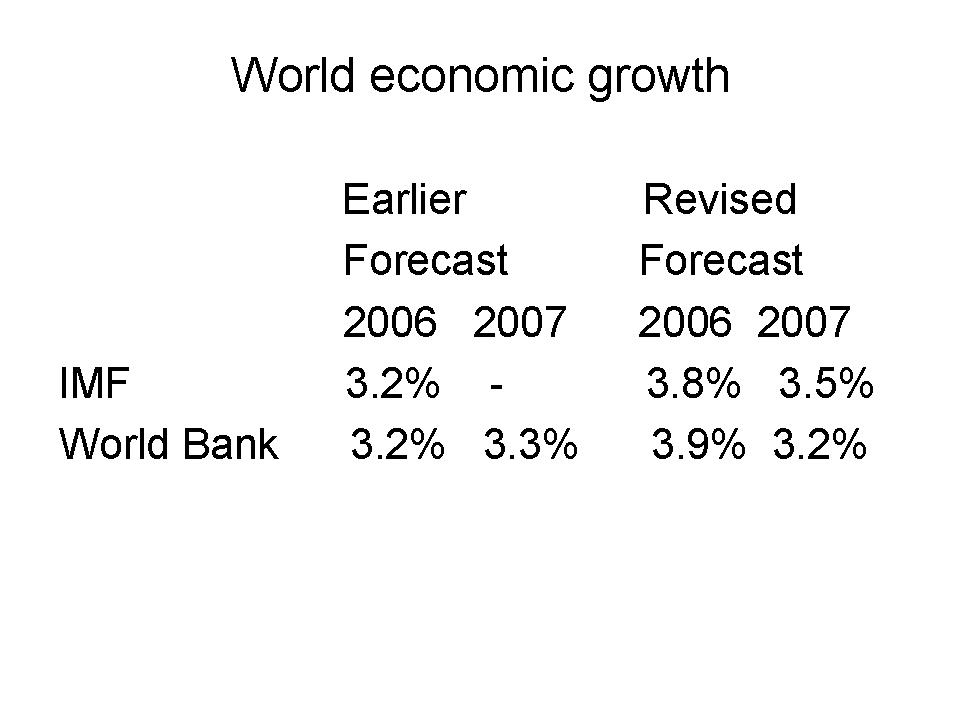
This has turned out to be a better year for the world economy than most people had expected. Both the IMF and the World Bank have revised upwards their projections for 2006. (See table alongside- the IMF forecasts from World Economic Outlook, September 2005 and September 2006; the World Bank forecasts are from Global Economic Prospects 2006 and 2007.). In 2007, both see a deceleration in growth with the IMF projecting a smaller deceleration than the World Bank. Note that the projected growth rates are still above the trend rate of 3% seen in the period 1980-2000.
So, the Cassandras have been proved wrong. They were telling us that the world economy would be on the skids for a number of reasons:
* Oil prices would go cross $100
* America's current account imbalances would unwind in ways that would derail the world economy
* America's housing sector would see a huge bust
So, what happened? Well, American current account imbalances remain. The housing sector has seen a slowdown but not a crash. But the biggest surprise has been oil prices. Oil prices were ruling above $75 in August. They have gone below $60. This is a level that the world economy can shrug off.
The decline in oil prices has meant that inflationary tendencies have been curbed everywhere and interest rate increases in the industrial world, including the US, have not seemed inevitable. In the US, the gradual slowing down of the economy- the much awaited 'soft landing'- has also meant that the US Fed has not been under pressure to raise interest rates.
I believe that one factor, more than anything else, has changed the global economic outlook dramatically: Israel's failed offensive on Lebanon in July.What's the connection?, you might wonder. It goes like this. America had planned an all-out assault on Iran, aimed at decimating Iran's nuclear facilities and defence infrastructure. But before this happened, the Iran-backed militia in Lebanon had to be neutralised. Otherwise, the Hezbollah would react to an American assault on Iran by launching long-distance missiles into the heart of Israel.
The Israelis got the opportunity they were looking for when the Hezbollah abducted two of their soldiers (although this was in retaliation for earlier Israeli abductions). They tried to pulverise the Hezbollah from the air. That didn't work. So they launched a ground offensive. To their chagrin, they ran, not into the sort of ragtag bunch of guerillas they had encountered in the West Bank and Gaza, but a force that was fully prepared for an invasion, well equipped and superbly trained. The offensive was called off.
This meant that war in the Gulf had been averted for the time being. The 'terror premium' built into oil prices vanished and oil prices started climbing down. That gave the world economy a huge boost. It follows that the key risk to the world economy in 2007 is America's policy towards Iran. The Bush-Blair duo faces a humiliating rout in Iraq and might want to salvage its legacy by announcing that Iran has ceased to be a nuclear threat to the world. If that happens, all bets on global economic growth continuing are off.
Barring a US-led war against Iran, the world economy should chug along and there is a good chance that growth will exceed the Fund-Bank forecasts in 2007.
Subscribe to:
Posts (Atom)