Talk of 'financial inclusion'and many people will start yawning. 'Inclusive growth' is something of a buzzword now and many might be forgiven for supposing that it's one of those expresssions politicians love to include in their speeches. Makes growth look so much more respectable.
Yet, financial inclusion is not something to bracketed with, say, the employment guarantee scheme. I argue in my latest ET column that banks should go for it because it makes excellent commercial sense. Banks have a problem accessing deposits. Reaching out to under-banked areas would help them get low-cost, stable deposits. It would also help them make loans with higher yields than what they can charge corporates today.
Banks have had a cosy time these past few years because of the surge in liquidity and because savers have been wary of the capital market. On the asset side, top borrowers' demand for funds has diminished but banks have substituted them with retail assets. As a result, banks have been able to maintain their net interest margin, the difference between interest income and interest expense as a proportion of assets.
This run of luck won't continue. Banks' net interest margin is bound to come under pressure as savings seek out higher returns in the capital markets and elsewhere and the best borrowers continue to exit the banking system. Financial inclusion could be an excellent bet for banks in commercial terms.
The trick is to get banks to put systems in place to measure risk-adjusted return on capital (Raroc). Thanks to Basel II, banks will know the capital allocated, the denominator in Raroc. They need to get a handle on the numerator as well, the return adjusted for risk. When Raroc is measured and monitored, banks will get their pricing right. And the key to taking risks is largely pricing risk correctly. So, more than re-working priority sector loans, the RBI must push banks towards using Raroc.
Read my ET column.
Thursday, November 30, 2006

Tuesday, November 07, 2006
India and China: the 1962 war revisited
China's President Hu Jintao is due to make a four-day visit to India starting November 20.There has been some comment on the seeming lack of enthusiasm on the Indian side. Where are Sino-Indian relations headed? I address this question obliquely in my recent column in the Economic Times on the occasion of the 44th anniversary of the Sino-Indian border conflict.
China's growing economic and military power has translated into greater Chinese assertiveness in South Asia. China has followed a policy of 'strategic encirclement' in South Asia: it has forged greater economic and military links with India's neighbours with the objective of ensuring that India is confined to the south Asian space. It has also worked hard for the creation of a south Asian nuclear free zone so that, again, India stays put as a sub-regional power. China justified its relationships with south Asian countries by invoking Panch Sheel. It says it has every right to develop whatever relationship it likes with other sovereign countries.
Fair enough. But how does China justify its clandestine support to Pakistan's nuclear weapons programme all these years? More help on the nuclear front is on the agenda when Hu visits Pakistan before he arrives here.
It is the China factor, more than any other consideration, that explains India's gradual drift towards a closer relationship with the US, a process started by the NDA government and carried forward by the UPA government. That is what explains Manmohan Singh's single-minded pursuit of the Indo-US nuclear in the face of considerable scepticism within the country and at the risk of alientating some of India's friends in the non-aligned and Muslim world.
China's attempts at 'strategic encirclement' will now be countered by India becoming a partner in American attempts at containing China, an exercise in which Japan, the east Asian countreis and some of the central Asian republics will be the other partners.
Read my full article in ET here.
Incidentally, I had promised people that this blog would not be just about banking and the Indian economy. I have been true to my word!
China's growing economic and military power has translated into greater Chinese assertiveness in South Asia. China has followed a policy of 'strategic encirclement' in South Asia: it has forged greater economic and military links with India's neighbours with the objective of ensuring that India is confined to the south Asian space. It has also worked hard for the creation of a south Asian nuclear free zone so that, again, India stays put as a sub-regional power. China justified its relationships with south Asian countries by invoking Panch Sheel. It says it has every right to develop whatever relationship it likes with other sovereign countries.
Fair enough. But how does China justify its clandestine support to Pakistan's nuclear weapons programme all these years? More help on the nuclear front is on the agenda when Hu visits Pakistan before he arrives here.
It is the China factor, more than any other consideration, that explains India's gradual drift towards a closer relationship with the US, a process started by the NDA government and carried forward by the UPA government. That is what explains Manmohan Singh's single-minded pursuit of the Indo-US nuclear in the face of considerable scepticism within the country and at the risk of alientating some of India's friends in the non-aligned and Muslim world.
China's attempts at 'strategic encirclement' will now be countered by India becoming a partner in American attempts at containing China, an exercise in which Japan, the east Asian countreis and some of the central Asian republics will be the other partners.
Read my full article in ET here.
Incidentally, I had promised people that this blog would not be just about banking and the Indian economy. I have been true to my word!
Friday, October 13, 2006
Twinkle, twinkle, banking star
| ||||||||||||||||||||
Bank stocks are back in favour. Consider the relative performance of the Bankex, the index for the banking sector in India, and the Sensex, the market index. In the six months upto September 2006, the Bankex underperformed the Sensex. In the last one month, the Bankex has outperformed the Sensex. Why so?
I can think of three reasons:
- There are signs of a softening of interest rates over the past month with oil prices trending downwards.
- In April, the RBI, in its annual credit policy statement, declared its intention to slow down credit growth from 30% in the previous year to 20% in 2006-07. So far, that hasn't happened- credit growth year on year upto stayed at over 30%.
- The last quarter GDP growth turned out to be higher than expected-8.9%. This has caused many forecasters to believe that GDP is more likely now to end up at the upper end of the 7.5-8% band they had projected. Bank stocks are a play on the economy, so what's good for the economy is good for bank stocks.
A buoyant economy boosts volume growth, of course, but it helps in other ways as well. Non-performing assets (NPAs) at banks tend to decline- and we must remember that asset quality in Indian banking is at its best today. There is no imminent danger of this being reversed because leverage among Indian firms is at its lowest in years- 1.06 according to Brics Securities. (Indeed, over the past couple of years banks have been effecting impressive recoveries from past NPAs.) The rising proportion of housing loans in the overall portfolio also makes for improved asset quality.
Secondly, when economic activity is high, so are float funds in the system. These tend to lower banks' cost of funds. That explains why banks' net interest margins (the difference between interest income and interest expense as a proportion of assets) have remained steady or even gone up in some instances despite an increase in interest rates. Higher interest rates on term deposits are offset by the lower cost on CASA (current and savings accounts), the proportion of which tends to go up with increased economic activity.
I have said elsewhere that Indian banking enjoys what would be regarded as an 'impossible trinity' in banking- high volume growth, high asset quality and high net interest margins. What I have stated above sheds light on why this is so. Bank investors, rejoice!
Wednesday, October 11, 2006
Household credit: how India stacks up
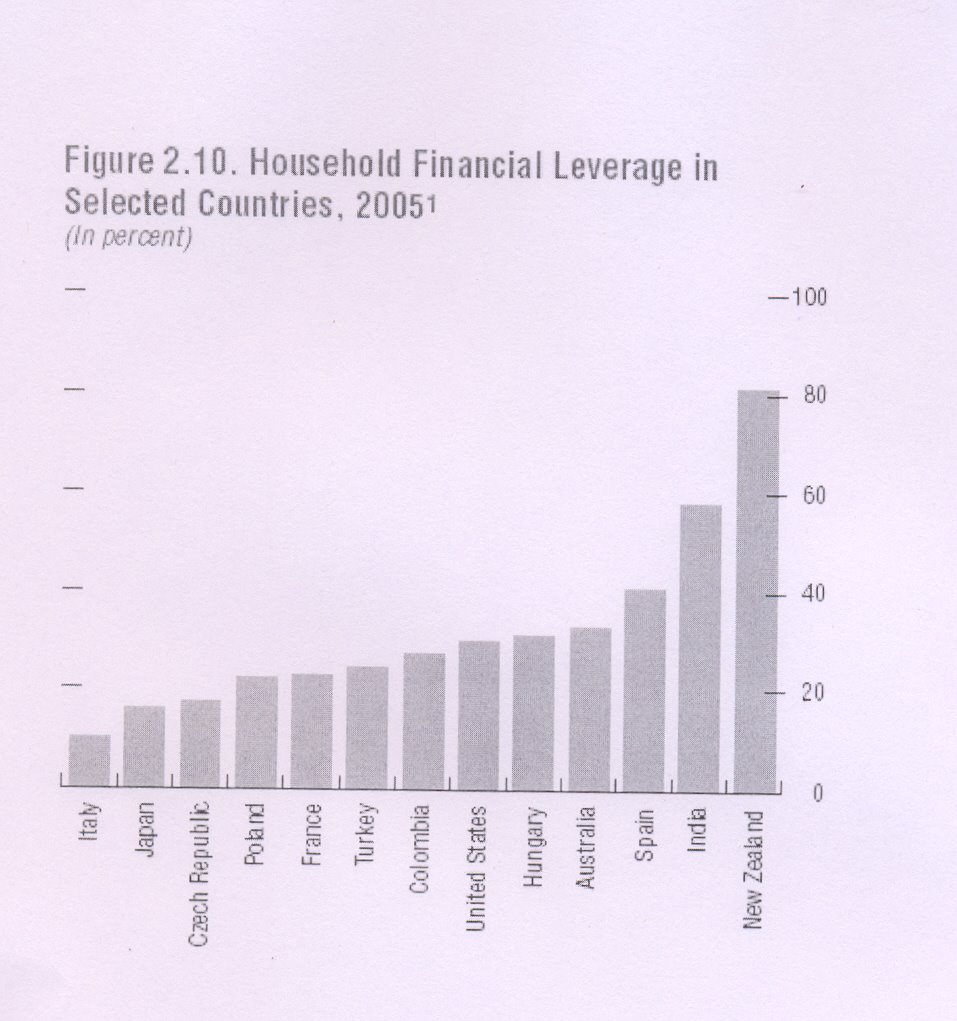
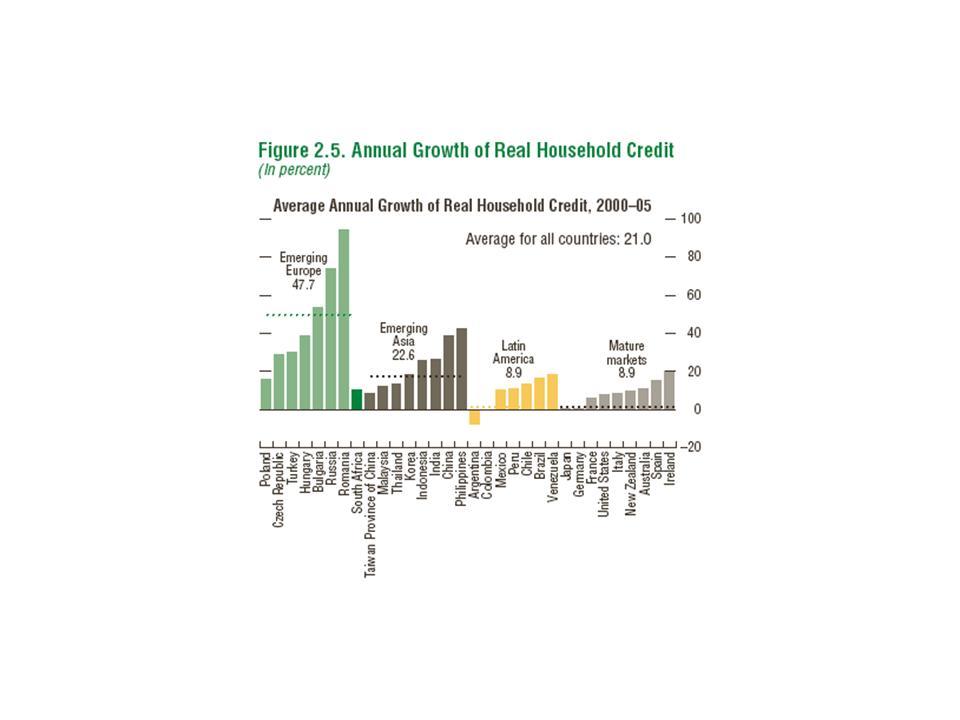
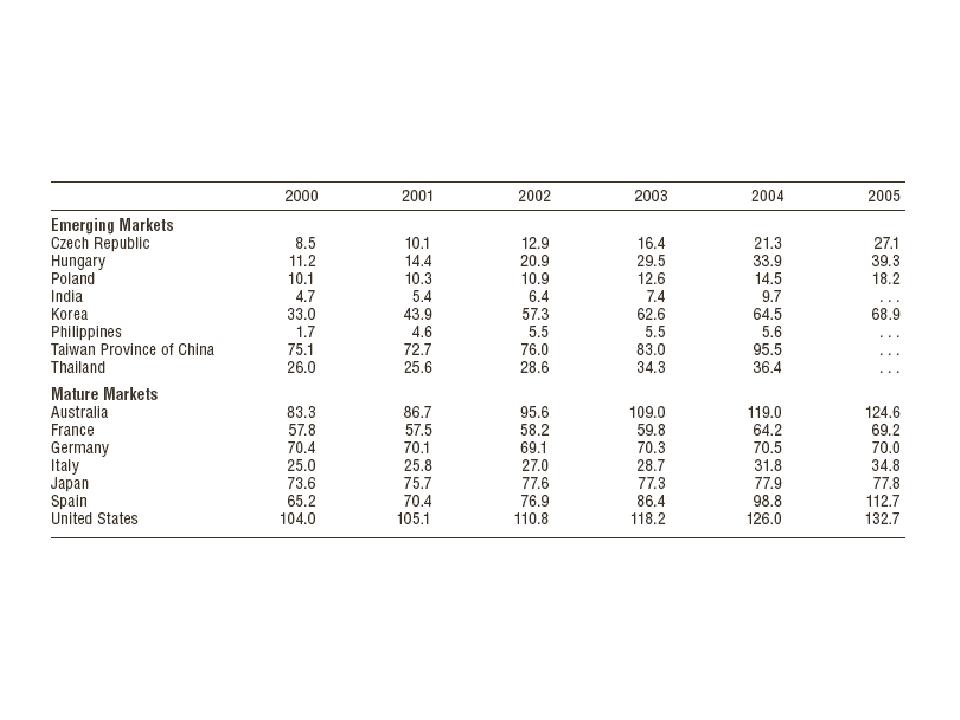
Retail or household credit in India has been growing at breakneck speed. In 2000-05, 25% of the incremental credit came from retail credit. For some banks, retail credit has been as high as 50-70% of additional loans. Is this sustainable? Does it spell trouble for banks, meaning, high non-performing assets down the road?
Answer to the first question: we should expect to see a slowing down because growth is now taking place on a higher base. Secondly, demand for credit from corporates has revived strongly, so banks can expect to grow their portfolios with a better balance between wholesale and retail credit.
As for the second question, the IMF's Global Financial Stability Report (September, 2006) has figures and tables that help place household credit in India in perspective.
The salient points in the two figures and one table reproduced above:
- While retail credit has grown strongly in India, growth is still lower than in emerging Asia and emerging Europe.
- Household credit as a proportion of disposable income in India is the second lowest (after Korea) among a sample of emerging as well as mature markets.
- Household leverage in India is the second highest among a sample of countries, after New Zealand.
Should we worry about high leverage in Indian households? Not really. For at least three reasons:
- The overall figure for leverage is an average across highly indebted rural households and urban ones. It does not give a correct picture of the segments banks are targeting for retail credit- salaried professionals and high net worth individuals
- Most loans are made against future income, not assets
- The biggest chunk of retail loans (nearly 50% of retail exposure) is housing loans on which defaults are- and banks have a solid collateral.
The bottomline: household credit in India can continue to grow strongly without posing problems for the banking sector.
Sunday, October 08, 2006
Credit growth in India: don't push the panic buttons yet
Rapid credit growth gives regulators an attack of nerves- they tend reflexively to associate these with a coming bust. To regulators, runaway credit growth is a sure sign that bankers are compromising on credit quality and that massive non-performing assets will follow.
Scheduled commercial banks' commercial credit- or 'non-food credit' as it is called- grew at 30.8% year on year in 2005-06. This was on top of growth of 28.8% in same period in 2004-05. There is little sign of a slowdown in 2006-07- in July 2006, y-o-y growth was 32.9%.This appears to have the RBI a trifle worried. It would like to see credit growth slowing down to 20% in the coming year.
I believe this concern is a trifle overdone. It's not aggregate credit growth alone that matters. You need to look at three factors: the composition of credit (especially corporate versus retail, exposure to sensitive sectors); the sources of funds for banks (domestic currency versus foreign currency); and whether there are signs of macroeconomic balances. I argue in my column in the
Economic Times that, viewed in relation to these factors, the credit growth we are seeing does not warrant undue concern.
I didn't have a chance to mention in my column that the RBI itself took a rather benign view of credit expansion in its Report on Trend and Progress in Banking in India (2004-05)- box on page 68. It noted that credit expansion in 2004-05 was more broad-based than in the previous years, with credit to industry and agriculture joining the retail sector in driving the demand for commercial credit. It also noted that NPAs in the retail sector, which has provided some of the impetus to credit growth, are still low- around 2%. "Therefore", the RBI concluded, " if banks put adequate risk monitoring and management systems in place, there should not be much cause for concern for the future, although past performance may not always be a good guide".
This was in the Report released in November 2005. Maybe the RBI reckons that three years in a row of rapid credit growth is a bit too much. Remember, however, that GDP growth continues to be robust.Let me qualify my upbeat assessment by saying that, while credit growth may not pose systemic risks, some banks could be asking for trouble.
At least some of the lending rates point to under-pricing of risk by public sector banks. They have responded to rate cuts effected by some of the savvier private banks. But the private banks know what they are doing. They have systems to measure return on capital for any given borrower, retail or wholesale. Not so the public sector banks. The RBI's response has been to increase risk weights for various retail loans. That should cause errant banks to take a closer look at their pricing. But there could be banks out there that fail to make the link between capital allocation and pricing.
Scheduled commercial banks' commercial credit- or 'non-food credit' as it is called- grew at 30.8% year on year in 2005-06. This was on top of growth of 28.8% in same period in 2004-05. There is little sign of a slowdown in 2006-07- in July 2006, y-o-y growth was 32.9%.This appears to have the RBI a trifle worried. It would like to see credit growth slowing down to 20% in the coming year.
I believe this concern is a trifle overdone. It's not aggregate credit growth alone that matters. You need to look at three factors: the composition of credit (especially corporate versus retail, exposure to sensitive sectors); the sources of funds for banks (domestic currency versus foreign currency); and whether there are signs of macroeconomic balances. I argue in my column in the
Economic Times that, viewed in relation to these factors, the credit growth we are seeing does not warrant undue concern.
I didn't have a chance to mention in my column that the RBI itself took a rather benign view of credit expansion in its Report on Trend and Progress in Banking in India (2004-05)- box on page 68. It noted that credit expansion in 2004-05 was more broad-based than in the previous years, with credit to industry and agriculture joining the retail sector in driving the demand for commercial credit. It also noted that NPAs in the retail sector, which has provided some of the impetus to credit growth, are still low- around 2%. "Therefore", the RBI concluded, " if banks put adequate risk monitoring and management systems in place, there should not be much cause for concern for the future, although past performance may not always be a good guide".
This was in the Report released in November 2005. Maybe the RBI reckons that three years in a row of rapid credit growth is a bit too much. Remember, however, that GDP growth continues to be robust.Let me qualify my upbeat assessment by saying that, while credit growth may not pose systemic risks, some banks could be asking for trouble.
At least some of the lending rates point to under-pricing of risk by public sector banks. They have responded to rate cuts effected by some of the savvier private banks. But the private banks know what they are doing. They have systems to measure return on capital for any given borrower, retail or wholesale. Not so the public sector banks. The RBI's response has been to increase risk weights for various retail loans. That should cause errant banks to take a closer look at their pricing. But there could be banks out there that fail to make the link between capital allocation and pricing.
IDBI-UWB Merger
The merger of IDBI with United Western Bank (UWB)is through. IDBI intends to treat UWB as a separate business unit. That makes sense. The arm's length relationship will enable IDBI to cash in on UWB's strengths- high quality customer service, rural loans- without IDBI's having to
tackle the people issues that a merger will entail. Once some of the stressed assets are recovered and UWB is put on a sound footing, the full value of the merger will become evident- and IDBI's price should appreciate.
My initial comments on the merger in my ET column.
tackle the people issues that a merger will entail. Once some of the stressed assets are recovered and UWB is put on a sound footing, the full value of the merger will become evident- and IDBI's price should appreciate.
My initial comments on the merger in my ET column.
Friday, September 08, 2006
Going slow on convertibility
The RBI made public the Tarapore committee report on Capital Account Convertibility (CAC) late August. Even "fuller" convertibility than we have now isn't going to happen soon, if the authorities accept the recommendations of the committee. It will happen in three phases starting: Phase I-2006-07. Phase II: 2007-09 and Phase II- 2009-11. Considering the downside risks to CAC, that is just as well.
I have commented on the report in my column in the Economic Times.
There are some points I didn't have a chance to make in my column:
I have commented on the report in my column in the Economic Times.
There are some points I didn't have a chance to make in my column:
- PNs: The Finance ministry is reluctant to phase out PNs because of the likely impact on the stock market. This is being myopic. It is far more important to ensure the integrity of the financial system and to show that you are practicing “zero tolerance” in respect of KYC norms. Over the long run, this will do a lot to inspire confidence in the Indian financial system and encourage inflows. The benefits will outweigh whatever we gain from the surge in PNs at the moment. The RBI has taken a tough line towards banks found to flouting KYC norms in the IPO scam. It would be inappropriate to practise laxity in this respect towards foreign investors at the same time.
I said in my piece that the answer to the PN issue may to allow direct investment by non-residents right away. But this presumes that we are confident about banks’ grip on KYC. If we are uncertain about this, it is better to defer direct investment by non-residents. - Banking system: Tarapore II wants industrial houses to be allowed to set up banks- with immediate effect, something that surprises even ultra-liberaliser and dissenting member Surjit Bhalla. This would be a major departure for RBI. I can’t see how this can be done without violating the ceiling of 10% on ownership in private banks and the requirement of diversified ownership.
- Data: The committee has asked for liberalisation of outward remittances by Indians going up to $200,000 in the last phase. What has been the experience with the current limit of $25,000? Do we have data? Perhaps we should have a norm for such outflows in relation to reserves/imports. And, of course, we should have the capacity to monitor and cut-off outflows- a real-time monitoring system that can be acted up on in times of crises.
Subscribe to:
Posts (Atom)